Glowing Glass in Tesla's Bare Hand: 1894's Tubes
The 1894 File · No. 12 of 12. Every quote below is cited from the first edition, page numbers included.
Published: October 26, 2026 | Updated: October 26, 2026
Standfirst. In February 1892 Nikola Tesla took an exhausted glass tube with no wires in it in his hand, and it lit up. The 1894 first edition prints that demonstration, the nine pages about exciting a tube without wires that are four different texts by four different men, and the lamp Tesla tried to build out of the same glow. Every sentence below is cited to a printed page of that edition, and says whose sentence it is.
Four Texts, Four Voices, Nine Pages
The volume's own index files this subject under "Electric Discharges in Vacuum Tubes" (1894, p. 494). The chapter it points at is chapter XXXII, printed pages 396 to 406. Nine pages, four texts, four authors, and only two of the four texts are by the man the story is about.
The chapter's footnotes date them. The first part is Tesla's own article: "Article by Mr. Tesla in The Electrical Engineer. N. Y., July 1, 1891." (1894, p. 396). That article runs to the middle of printed p. 402, where a display heading opens an abstract of a paper J. J. Thomson read to the Physical Society of London, in a reporter's third person, and the abstract fills the rest of printed pp. 402 and 403. Printed page 404 is Tesla's reply, dated by its footnote to August 26, 1891. Printed page 406 is Tesla introducing and then reprinting the communication he was answering, which is Thomson's note in the London Electrician of July 24, 1891, dated by the chapter's own footnote. The July 24 note answers the July 1 article and the August 26 article answers the note; the volume prints them in the other order. Two more texts this page quotes are whole chapters of their own: the lecture Tesla delivered at Columbia College on May 20, 1891 (1894, p. 145), and the lecture he delivered before the Institution of Electrical Engineers in London in February 1892 (1894, p. 198).
So "Tesla wrote it in 1894" is wrong in several ways at once. The book is 1894. The texts are 1891 and 1892. Three of the four passages in the only chapter the volume devotes to tubes without wires are not his.
The chapter also names two men called Thomson in one sentence, and they are not the same person. Tesla opens: "In The Electrical Engineer of June 10 I have noted the description of some experiments of Prof. J. J. Thomson" (1894, p. 396), and in the same breath: "in your issue of June 24 Prof. Elihu Thomson describes an experiment of the same kind" (1894, p. 396). J. J. Thomson is the Cambridge man whose abstract and published note fill printed pages 402 to 406. Elihu Thomson is an American inventor describing a different experiment in a different magazine. After that sentence the chapter's prose says 'Prof. Thomson' with no initial at all. Every sentence on this page says which one.
The abstract reads like the prose around it, which is how it ends up quoted as Tesla's. It is not his. "The phenomena of vacuum discharges were, Prof. Thomson said, greatly simplified when their path was wholly gaseous, the complication of the dark space surrounding the negative electrode, and the stratifications so commonly observed in ordinary vaciium tubes, being absent" (1894, p. 402). The tell is grammar: 'Prof. Thomson said', not 'I found'. And 'vaciium' is what the volume sets, not what a transcriber typed. The same printed page carries the end of Tesla's own article before the abstract heading, so the first-person sentences on printed p. 402 are his and the reported ones are the abstract's.
That trap has produced the most-misquoted sentence attached to this subject, and in the print it starts in the middle of a sentence of its own: "the first experiment I tried with the discharge of a Leyden jar produced luminosity in the tube, but it was not until after six weeks' continuous experimenting that I was able to get a discharge in the exhausted tube which I was satisfied was due to what is ordinarily called electrodynamic action" (1894, p. 406). The "I" is J. J. Thomson, about his own apparatus, in a note he published himself. Tesla's own bench time is dated by Tesla, differently: "My investigations in this line occupied me principally during the winter and spring of the past year" (1894, p. 396), in an article footnoted to July 1891. A retelling that says Tesla spent six weeks on this has taken Thomson's sentence and given it to the wrong man.
The book's letters are the book's letters. Inside the quotes this page carries, the volume sets 'vaciium' for vacuum at printed p. 402, 'plaeed' and 'inclose proximity' at p. 403, 'J urther' at p. 403, 'to eparate' for 'to separate' at p. 406, 'viorate' at p. 176, 'f rictional' at p. 288, 'Avill' for 'Will' and 'II. S. A.' for 'U. S. A.' at p. 253. Each of those is one occurrence in the whole volume, measured, at the page named. Quotes here carry them. A silently corrected 1894 is worse than a wrong one, because a reader cannot check it and the matcher fails on the corrected form.
One more boundary, because readers expect X-rays here. The editor writes that the volume "deals simply with his work accomplished to date" (1894, p. 6), and adds: "It is needless to say that at this moment Mr. Tesla is engaged on a number of interesting ideas and inventions, tobe made public in due course" (1894, p. 6). 'tobe' is the scan's spacing, not ours. The newest text quoted here is February 1892. Counted over the whole text, 'X-ray' is 0, 'X rays' 0, 'x ray' 0, 'Röntgen' 0, 'roentgen' 0. Röntgen's work on cathode radiation belongs to 1895, which is outside the volume and outside this chapter's own fence of 1891. The absence is a date fence. It is not evidence that he anticipated X-rays, and it is not evidence that he missed them.
The Tube in His Hand, and the Question It Left
The demonstration is in the February 1892 London lecture, at printed p. 288: "I take a tube in my hand and move it about, and it is lighted wherever I may hold it; throughout space the invisible forces act" (1894, p. 288).
This series' page on lamps that lit without wires prints the other sentences of this passage, including the line in which he says an unskilled lecturer had best begin and end with effects of this kind. That page is the right page for that passage, so this one describes it and does not print it again.
What follows on the next printed page is the part this page is for. "Since I have exhibited these phenomena for the first time, I have obtained some other interesting effects" (1894, p. 289). Then the objects change. "It was of interest to see how some of the phosphorescent bulbs of Professor Crookes would behave with these currents, and he has had the kindness to lend me a few for the occasion" (1894, p. 290). "The effects produced are magnificent, especially by the sulphide of calcium and sulphide of zinc" (1894, p. 290). "With the disruptive discharge coil they glow intensely merely by holding them in the hand and connecting the body to the terminal of the coil" (1894, p. 290).
The brightness claim is made for a coated bulb, not for a bare tube: "A small phosphorescent bulb, when attached to a wire connected to a coil, emits sufficient light to allow reading ordinary print at a distance of five to six paces" (1894, p. 289). The size of the electrode that drives it: "Intense phosphorescence may be excited in a bulb by merely connecting it to a plate within the field, and the plate need not be any larger than an ordinary lamp shade" (1894, p. 289). The two ways of exciting one tube, in his own note on the coatings he puts on it: "These coatings are merely used to enable me to perform two experiments with the tube ... to produce the effect desired either by direct connection of the body of the experimenter or of another body to the wire w, or by acting inductively through the glass" (1894, p. 289). His own body is one side of that circuit, and the cut in that quote is where the print sets a dash.
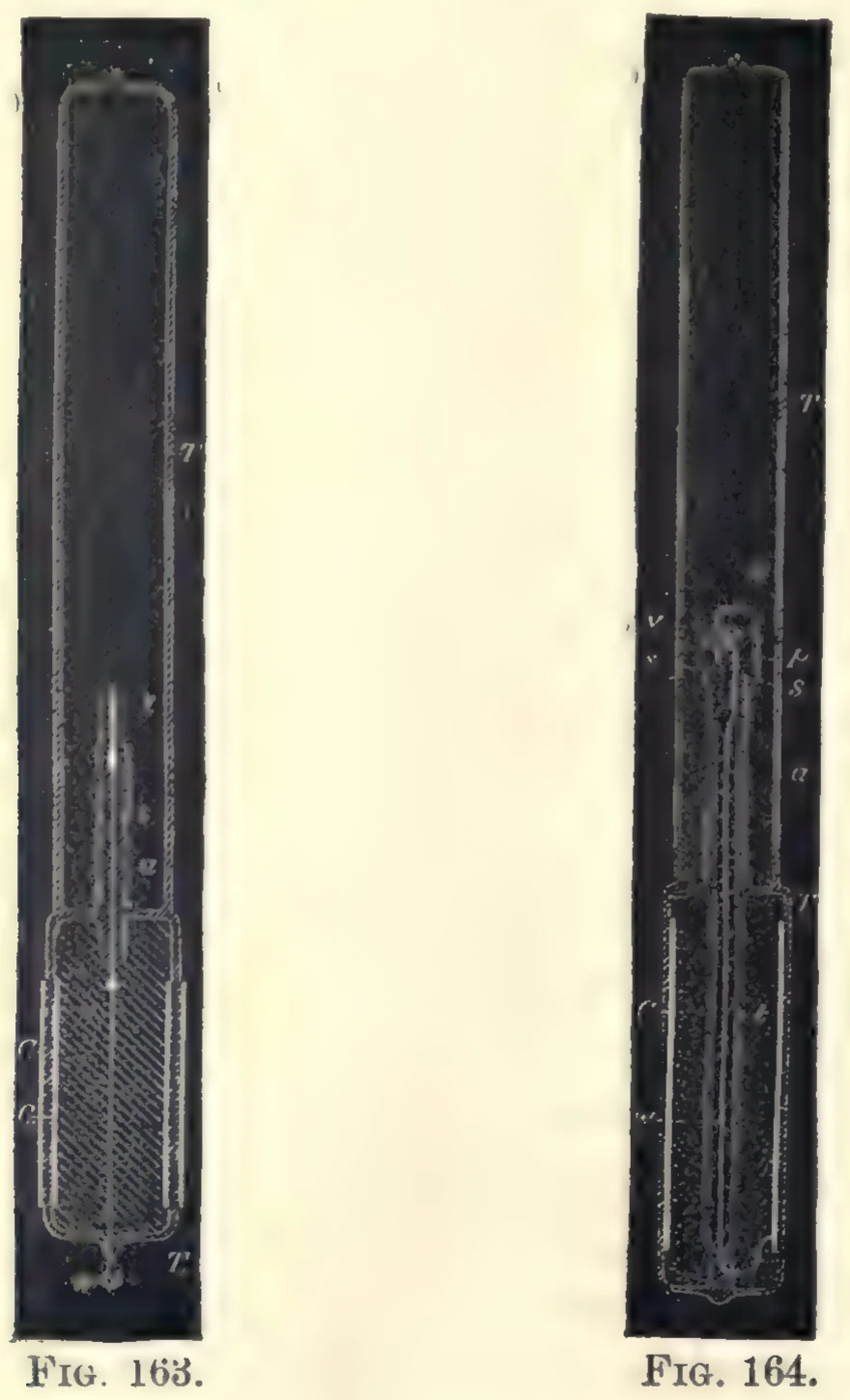
Then the engineering sentence, which is the opposite of the miracle reading: "I have produced the incandescence of a button, filament, or wire enclosed in a tube. To get to this result it was necessary to economize the energy which is obtained from the field, and direct most of it on the small body to be rendered incandescent" (1894, p. 289).
One caution about holding a tube like that. In the 1891 New York lecture he says that at low frequency the current needed to hold a four-foot tube at a given brightness "is so powerful that, I think, it might produce serious injury to those not accustomed to such shocks" (1894, p. 176), and that at twenty thousand alternations per second the same brightness is produced "without any effect being felt" (1894, p. 176). Neither sentence is a safety instruction for a reader with a coil at home. The series' caution about physiological effects sits on the other page, where it belongs.
Then the second tube, which is the beginning of a different problem. "But I may take another tube and it might not light, the vacuum being very high" (1894, p. 288). "I excite it by means of a disruptive discharge coil, and now it will light in the electrostatic field" (1894, p. 288).
The sentence this passage leaves behind is the one worth taking seriously. "What change have I produced in the tube in the act of exciting it?" (1894, p. 288). The form that circulates, 'What change have I produced in the tube?', is not what the print says, and it makes him ask a dumber question. The same sentence is printed and correctly cited on the lamps without wires page of this series; this page raises it because everything below is an attempt to answer it.
He tries two answers in the next two sentences and rejects both. "If a motion imparted to atoms, it is difficult to perceive how it can persist so long without being arrested by f rictional losses" (1894, p. 288). And: "if a strain exerted in the dielectric, such as a simple electrification would produce, it is easy to see how it may persist indefinitely, but very difficult to understand why such a condition should aid the excitation when we have to deal with potentials which are rapidly alternating" (1894, p. 288).
He tells the audience what the lecture is for: "It has been, my chief aim in presenting these results to point out phenomena or features of novelty, and to advance ideas which I am hopeful will serve as starting points of new departures" (1894, p. 292). The lecture closes on a half-sentence that cannot be printed whole here, because the print sets two pairs of dashes around a parenthetical and this series does not print them: "the pleasure I have had in presenting these results to a gathering of so many able men" (1894, p. 293).
Why a Tube Lights With No Wires
The book's own sentence for the mechanism is the second paragraph of the chapter about it: "The fundamental idea in these experiments is to set up an electromotive force in a vacuum tube ... by means of electro-magnetic induction, and to excite the tube in this manner" (1894, p. 396). The cut is where the print sets a dash, and the comma form does not verify: 'in a vacuum tube, preferably devoid of any electrodes, by means of' comes back fuzzy 0.991 on the matcher. The words doing the work are electromotive force and induction. Nothing is connected to the tube, and something is still driving it.
Then the component, in the period's word: "the idea of replacing the tinfoil coatings of a Leyden jar by rarefied gas and exciting luminosity in the condenser thus obtained by repeatedly charging and discharging it" (1894, p. 396). 'condenser' is 225 times in this volume on the raw index and 218 on the index the quote gate builds. 'capacitor' is 0. The circuit in that sentence is the one a modern description would draw; the noun is not the one it would use.
The conditions he says the effect needs, written as a warning against reproducing it badly: "It must be remembered that in these experiments we have to deal with primary currents of an enormous frequency or rate of change and of high potential, and that the secondary conductor consists of a rarefied gas, and that under such conditions electrostatic effects must play an important part" (1894, p. 398). Then the sentence that removes the obvious objection: "To excite luminosity in the tube it is not absolutely necessary that the conductor should be closed" (1894, p. 398). A tube with no wires in it is not a contradiction. It is an open circuit whose second electrode is the gas inside the glass.
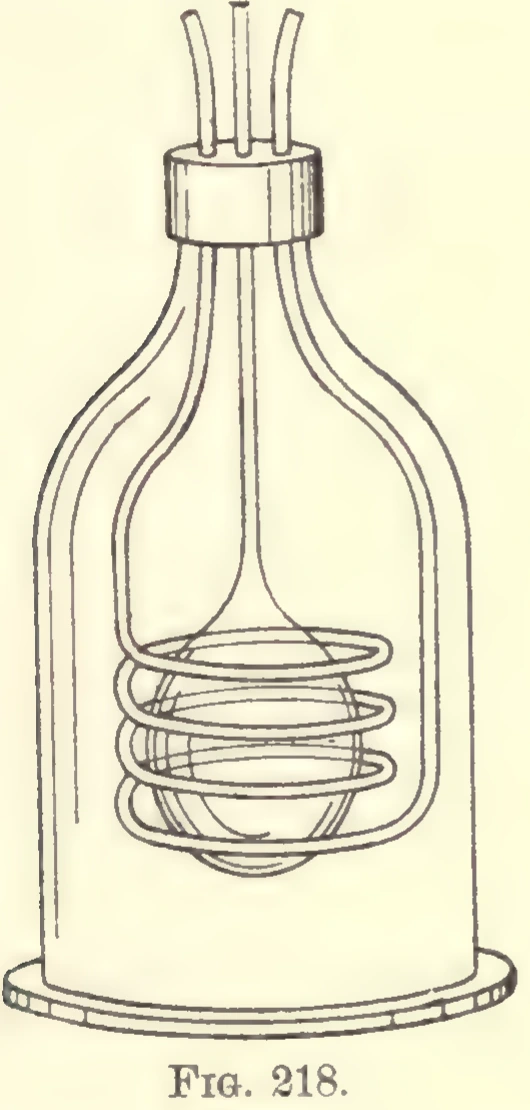
What happened, and what he built: "In all forms of apparatus used there was no special difficulty in exciting a luminous circle or cylinder in proximity to the primary" (1894, p. 397). The simplest form of it, in his words: "an ordinary exhausted tube (preferably of large diameter) be surrounded by a spiral of thick copper wire serving as the primary ... feebly luminous spiral may be induced in the tube" (1894, p. 399). The cut is the scan's and not an elision in the text: the OCR sets a footnote marker glued to the next word, so no joined form of that sentence is in the index at all. 'feebly' is his own word for the brightness, and it is the counterweight to every retelling in which the tube blazed.
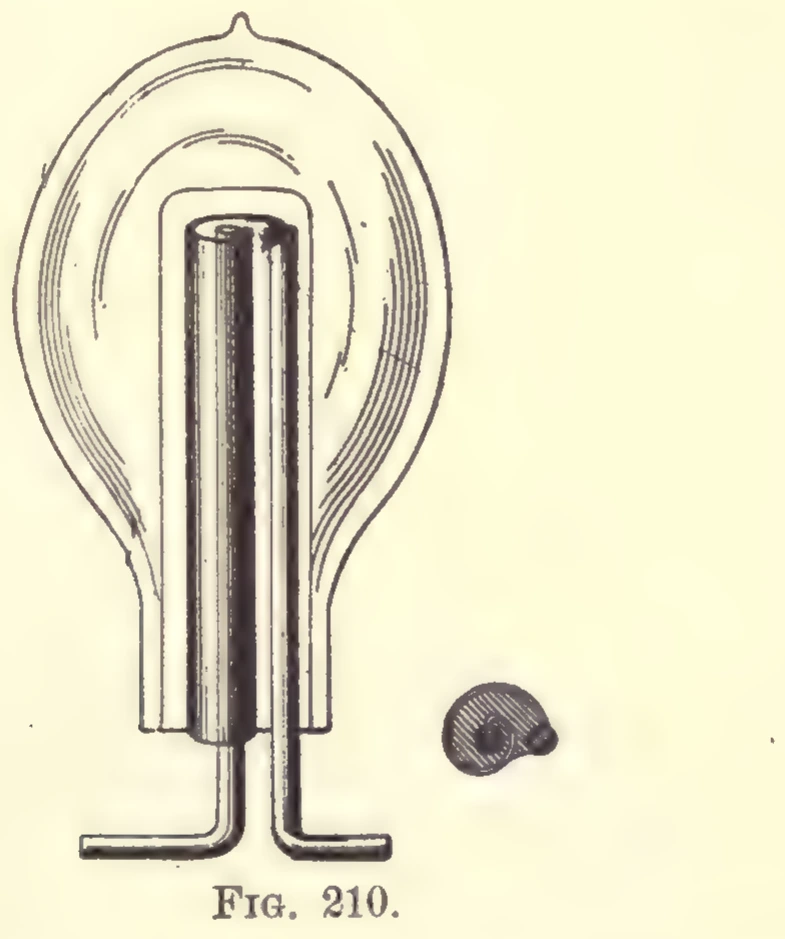
Then the observation that a plate does what a wire does: "the lamp-bulb was provided with a tinfoil coating on the side opposite to the primary and each time the tinfoil coating was connected to the ground or to a large object the luminosity of the circle was considerably increased. This was evidently due to electrostatic action" (1894, p. 399). The same effect at a distance, which is the part that makes the lecture trick work at all: "two intensely luminous circles, each of them close to a turn of the primary spiral, were formed inside of the tube, and I attributed this phenomenon to the existence of nodes on the primary" (1894, p. 399).
The New York lecture of May 1891 has the same argument a year and a half earlier, in plainer language, and it uses the phrase the query asks for: "an exhausted tube be introduced from the other side in the hollow space, the tube is lighted most intensely because of the increased condenser action, and in this position the striae are most sharply defined. In all these experiments described, and in many others, the action is clearly electrostatic" (1894, p. 186). 'condenser action' is in the volume 6 times, at printed pp. 152, 164, 165, 177, 186 and 385, and this is the one of the six that says an exhausted tube is lighted by it. 'striae' is 4, at printed pp. 144, 186 and 370 twice. In the nine pages of chapter XXXII it is 0, and the word the chapter uses for the bands is the other man's: 'stratifications', once, at printed p. 402.
Two other sentences from that same printed page, the one about a person standing on an insulated support lighting the tube by approaching the hand and the one about wiping the light out with a pass of the hand, are on this series' lamps without wires page. The page is shared; the sentences are not.
The Vacuum Problem, and the Tube That Would Not Light
The second tube on the lecture table is the engineering inside the demonstration, and it is the part neither man in this volume solved.
The trouble is on printed p. 288, quoted above: a tube pumped too highly does not light, and a disruptive discharge coil is what makes it light afterwards. The same fact read from the other end is in the chapter about the apparatus: "before the disruptive discharge takes place, the tube or bulb is slightly excited and the formation of the luminous circle is decidedly facilitated" (1894, p. 398). A tube that has been excited is easier to excite. That is 'retains the faculty of being excited' written as bench practice instead of as a question.
The New York lecture has the method for the worst case: "we may place a body in a very highly exhausted globe, in a non-striking vacuum, and, by employing very high frequencies and potentials, transfer sufficient energy from it to other bodies in the vicinity, or in general to the surroundings, to maintain it at any degree of incandescence" (1894, p. 175). 'non-striking' is the term of art for a vacuum that will not striate, and it is in the volume 6 times, at printed pp. 175, 242 twice, 275, 282 and 283.
The expectation he reports as false is on printed p. 177: "This is not confirmed by my experience; quite the contrary, the better the vacuum the more easily the bodies are brought to incandescence" (1894, p. 177). The intuition is that pumping more out leaves less to light. He tried it and printed the opposite.
Then his own failure, first person, on printed p. 402: "in one of my experiments in which a vacuum was produced by the Torricellian method, I was unable to produce the luminous band, but this may have been due to the weak exciting current employed" (1894, p. 402). He guesses at the cause and moves on.
The same wall is in the other man's apparatus, a page later, inside the abstract, so it is J. J. Thomson's observation and not Tesla's: "On exhausting the jar, however, the luminous discharge grew fainter, and a point was reached at which no secondary discharge was visible" (1894, p. 403). Past the limit the discharge does not stop, it relocates: "J urther exhaustion of the jar caused the secondary discharge to appear outside of the bulb" (1894, p. 403). 'J urther' is the scan's spacing, and the corrected form does not verify. Two men, two apparatuses, one printed page apart, both at the same point, neither of them explaining it.
Then the negative cases, which are what a retelling leaves out. Tesla, on printed p. 402: "the introduction of mercury or the heating of the bulb prevents the formation of the luminous band or shortens the after-glow; and also why in some cases a platinum wire may prevent the excitation of the tube" (1894, p. 402). 'after-glow' is in the volume once, in that sentence. The abstract, on the next printed page: "On heating the bulb, the duration of the glow was greatly diminished, and it could be instantly extinguished by the presence of an electro-magnet" (1894, p. 403). If a tube appears to remember, the memory is physical, and it can be erased.
The Argument About Which Force Did It
He says in print that he changed his own mind: "at the outset, I myself looked for a purely electrodynamic effect and believed that I had obtained it. But many experiments performed at that time proved to me that the electrostatic effects were generally of far greater importance" (1894, p. 404).
Then the sentence that stops the word being read the way we read it now: "In using the term electrostatic I had reference rather to the nature of the action than to a stationary condition, which is the usual acceptance of the term" (1894, p. 404). He is not claiming a stationary charge. He is claiming a coupling with a signature: it gets stronger when the material between the parts changes. "when the specific inductive capacity of the medium between the primary and secondary is increased, the inductive effect is augmented" (1894, p. 401).
His own best case, which he labels as such on the same printed page: "I have experimentally proved that if the same discharge which is barely sufficient to excite a luminous band in the bulb when passed through the primary circuit be so directed as to exalt the electrostatic inductive effect ... an exhausted tube, devoid of electrodes, may be excited at a distance of several feet" (1894, p. 402). The cut is where the print sets a pair of dashes, and each side verifies on its own. The words before it are his too, and they say what he is doing: 'My principal argument is the following'.
The tests that could have come out the other way are in the same pages, and he prints them: "the fact that a glow can be produced along the primary in the form of an open spiral argues for an electrostatic effect" (1894, p. 399); "the circles were always in close proximity to the primary and were considerably easier produced when the latter was very close to the glass ... and these facts speak for an electrostatic effect" (1894, p. 400); "a glass tube T slipped between the primary and the bulb, when the effect pointed out was noted. Were the action wholly electromagnetic no change could possibly have been observed" (1894, p. 401); "this bombardment being evident from the rapid heating of the glass near the primary. Were the bombardment not at right angles to the glass the heating could not be so rapid" (1894, p. 401). A wire closed on itself around the bulb does not stop the light: "when a bulb is surrounded by a wire closed upon itself and in the plane of the primary, the formation of the luminous circle within the bulb is not prevented" (1894, p. 401). A broad strip of tinfoil does: "But if instead of the wire a broad strip of tinfoil is glued upon the bulb, the formation of the luminous band was prevented, because then the action was distributed over a greater surface" (1894, p. 401).
The physical picture built on all of that is one sentence long: "there is a molecular bombardment inthe plane of the luminous circle at right angles to the glass" (1894, p. 400). 'inthe' is the scan's spacing, not the print's, and the spaced form verifies only through the index that ignores spaces.
Thomson's side of it. The abstract states the difficulty first: "To produce discharges in tubes devoid of electrodes was, however, not easy to accomplish, for the only available means of producing an electromotive force in the discharge circuit was by electro-magnetic induction" (1894, p. 402). It also answers the question a reader asks about the apparatus, which is what drove it: "Leyden jar, which combines the two essentials of a current whose maximum value is enormous, and whose rapidity of alternation is immensely great" (1894, p. 403). That sentence begins at the foot of printed p. 402 and the two halves never join in the index, because the page's own footnote sits between them, so only the p. 403 half can be quoted at all.
Then the two sentences that make this a dispute and not a discovery. Tesla, in his reply, in The Electrical Engineer, dated by the chapter's footnote to August 26, 1891: "I did not, as Prof. J. J. Thomson seems to believe, misunderstand his position in regard to the cause of the phenomena considered, but I thought that in his experiments, as well as in my own, electrostatic effects were of great importance" (1894, p. 404). Thomson, in the note Tesla reprints on the next printed page: "He seems, however, to have misunderstood my position with respect to the cause of these discharges, which is not, as he implies, that luminosity in tubes without electrodes cannot be produced by electrostatic action, but that it can also be produced when this action is excluded" (1894, p. 406).
Tesla's criticism of the evidence is a published criticism of a published report: "It did not appear, from the meagre description of his experiments, that all possible precautions had been taken to exclude these effects" (1894, p. 404). Thomson's method is in his own note: "Wet blotting paper is a sufficiently good conductor to screen off a stationary electrostatic effect, though it is not a good enough one to stop waves of alternating electromotive intensity" (1894, p. 406). Tesla's answer is a concession and an objection in one sentence: "Without doubting in the least that, with the care and precautions taken by Prof. J. J. Thomson, the luminosity excited was due solely to electrodynamic action, I would say that in many experiments I have observed curious instances of the ineffectiveness of the screening" (1894, p. 405).
The drawing most retellings use belongs to the other man. In the abstract: "An exhausted bulb ... containing traces of oxygen was plaeed within a primary spiral of three turns, and, on passing the jar discharge, a circle of light was seen within the bulb inclose proximity to the primary circuit, accompanied by a purplish glow, which lasted for a second or more" (1894, p. 403). 'plaeed' and 'inclose' are the volume's own letters, and the cut is the book's own figure label. Tesla's reply describes a different appearance: "in my experiments they were broad and often the whole of the bulb or tube was illuminated" (1894, p. 400), and the colour is a detail he credits to the other man rather than claims: "I have observed an intensely purplish glow, to which Prof. J. J. Thomson refers" (1894, p. 400). The two descriptions are in the same chapter and they do not match, which is why a retelling that describes a thin ring is describing Thomson's apparatus.
The last word in the volume on the argument is Thomson's, and it is close to the modern position, written in 1891: "Whilst the discharge of the jar is going on, it is difficult, and, from a theoretical point of view, undesirable, to eparate the effect into parts, one of which is called electrostatic, the other electromagnetic ; what we can prove is that in this case the discharge is not such as would be produced by electromotive forces derived from a potential function" (1894, p. 406). 'to eparate' is the book dropping the leading s of 'separate'. Nobody in these nine pages settled it. The volume prints both men saying the other misread him, and it prints neither of them proving the point.
The Lamp He Tried to Build Out of the Glow
The tube and the lamp are one problem in this book, and the sentence that joins them is in the New York lecture of May 1891, a year and a half before the carborundum passage: "we may place a body of some refractory material in a closed, and preferably more or less exhausted, globe, connect it to a source of ... high, rapidly alternating potential, causing the molecules of the gas to strike it many times a second at enormous speeds, and in this manner, with trillions of invisible hammers, pound it until it gets incandescent" (1894, p. 175). The cut is a stray bullet the OCR sets at the end of a printed line, not an elision in the text. 'invisible hammers' is in the volume once, and 'trillions' once, both on that page. It is the only number in the passage, and it is rhetoric.
The ambition is on printed p. 177: "in this manner a simple lamp capable of giving any desired candle power is provided" (1894, p. 177). 'candle power' is the period's unit, as two words, 5 times in the volume; 'candlepower' as one word is 0. The problem is named on the same page, before he has met it: "The success of lamps of this kind would depend largely on the selection of the light-giving bodies contained within the bulb" (1894, p. 177).
What he thought the lamp would be, in the February 1892 lecture: "We would then be simply using burners or flames, in which there would be no chemical process, no consumption of material, but merely a transfer of energy" (1894, p. 214). That framing, and the scaling law attached to it, are on this site's cold flame page, which is where the series carries the brush; the volume's own index keeps the two subjects apart too, filing 'High Potential, High Frequency : Brush Phenomena in High Vacuum' at printed p. 226 and 'Electric Discharges in Vacuum Tubes' at printed p. 396 (1894, p. 494).
What is not on that other page is the second half of the same hedge, which runs over the page break onto printed p. 214, after the clause article 06 prints: "One thing is certain, at any rate, and that is, that in augmenting the potential and frequency we rapidly intensify the streams ; and, though it may be very sanguine, it is surely not altogether hopeless to expect that we may succeed in producing a practical illuminant on these lines" (1894, p. 214). Read the double negatives. 'surely not altogether hopeless' is as far as he goes.
Then the material, in the February 1892 lecture itself, printed pp. 253 to 255. "In the course of these experiments a great many trials were made with all kinds of carbon buttons. Electrodes made of ordinary carbon buttons were decidedly more durable when the buttons were obtained by the application of enormous pressure" (1894, p. 253). "there can be no doubt that all kinds of carbon are fused under the molecular bombardment, but the liquid state must be one of great instability" (1894, p. 253). Two materials survived: "Of all the bodies tried there were two which withstood best - diamond and carborundum. These two showed up about equally, but the latter was preferable for many reasons" (1894, p. 253). The hyphen in that quote is in our text layer and not in the print: the print sets an em dash there, the extractor folds it to a hyphen, and the register pins the folded form. This series does not print the print's dashes, so the choice was between cutting the sentence in two and printing the fold. It is printed whole because cutting it would break the list the sentence is making, and to the voice gate a hyphen is not a dash.
He introduces the new material to a room of engineers: "As it is more than likely that this body is not yet generally known, I Avill venture to call your attention to it" (1894, p. 253), and then where it came from: "It has been recently produced by Mr. E. G. Acheson, of Monongahela City, Pa., II. S. A." (1894, p. 253). 'Avill' is the scan's 'Will' and 'II. S. A.' is its 'U. S. A.'. What he wanted from it: "Through the kindness of the inventor, I obtained a short while ago some samples which I desired to test in regard to their qualities of phosphorescence and capability of withstanding high degrees of heat" (1894, p. 253).
And how far he got: "The time has been too short to make a satisfactory study of the properties of this product, but enough experience has been gained in a few weeks I have experimented upon it to say that it does possess some remarkable properties in many respects" (1894, p. 254). The objects are on the lecture table: "I have here a number of bulbs which I have provided with buttons of carborundum" (1894, p. 254). The process, in his own words: "I take an ordinary lamp filament and dip its point in tar, or some other thick substance or paint which may be readily carbonized" (1894, p. 254). "The button being mounted in a bulb, when a good vacuum has been reached, first a weak and then a strong discharge is passed through the bulb to carbonize the tar and expel all gases, and later it is brought to a very intense incandescence" (1894, p. 254).
The obstacle is not the material. It is the glue: "The only difficulty which I have experienced in its use in connection with these experiments was to find some binding material which would resist the heat and the effect of the bombardment as successfully as carborundum itself does" (1894, p. 254). And the reason the lamp did not work: "The difficulty is that the binding material gives way, and the carborundum is slowly thrown off after some time" (1894, p. 255).
He tried the other hard material the same way: "I prepared buttons of diamond dust in the same manner as of carborundum, and these came in durability nearest to those prepared of carborundum, but the binding paste gave way much more quickly in the diamond buttons" (1894, p. 255). 'diamond dust' is in the volume once, in that sentence, at printed p. 255. His explanation for the difference is a guess about grain, not a measurement: "this, however, I attributed to the size and irregularity of the grains of the diamond" (1894, p. 255).
What he thought might come of it: "it might be found useful for coating the filaments of ordinary incandescent lamps, and I think that it is even possible to produce thin threads or sticks of carborundum which will replace the ordinary filaments in an incandescent lamp" (1894, p. 255). And the question he put to the material, which is the one the glow story keeps asking: "It was of interest to find whether carborundum possesses the quality of phosphorescence" (1894, p. 255). The answer he got back was no, for a reason he states: "they are good conducting, and it is a fact that conductors do not phosphoresce" (1894, p. 255).
The envelope is part of the device, and he says so inside the theoretical passage: "the importance of the quality of glass of which the tube is made" (1894, p. 405). That sentence is what makes the carborundum passage a lamp problem rather than a curiosity: the glass heats, the coupling goes through it, and the body inside it is being hit by the gas.
The volume filed this itself. Its index has an entry for "Carborundum Button for Tesla Lamps" (1894, p. 494), and it points at printed pp. 140 and 253. The first is the compiler's chapter, the second is the passage above.
What the passage does not contain is a number. Counted over printed pp. 253 to 259 on the index the quote gate builds: 'efficiency' 0, 'per cent' 0, 'watt' 0, 'candle power' 0, 'volts' 0, 'ampere' 0, 'output' 0, 'cost' 0, 'life' 0, 'hours' 0, 'measure' 1. The same range has 'experiment' 10 times and 'test' 5. He describes trials and comparisons and prints no measurement of the light coming out of them. That is a statement about these seven pages, not about him, and it is the whole of what this article can say about the lamp.
What the Internet Gets Wrong
The phrase is 'light without energy'. It is in this volume 0 times, so nobody in 1894 said it and it cannot be quoted at anyone here. The correction has to be made against the modern phrase, using his own sentences as the counterweight, and he has two of them. One is on printed p. 289, quoted above: the energy is obtained from the field and economised, which is the verb of a conservation argument, not of a miracle. The other is on printed p. 214, also quoted above: no consumption of material, merely a transfer of energy.
He uses the word efficiency, and he uses it about a lighting apparatus with a comparison attached: "This is due principally to the fact that a much smaller potential is required to produce the same light effect, and also to the higher efficiency in the light production" (1894, p. 176). What he does not do is write a figure next to it. Counted over chapter XXXII, printed pp. 396 to 406, on the index the quote gate builds: 'efficiency' 0, 'per cent' 0, 'watt' 0, 'candle power' 0, 'volts' 0, 'ampere' 0, 'output' 0, 'measure' 0, 'test' 0. The same nine pages have 'experiment' 38 times and 'electrostatic' 26. A chapter full of apparatus and comparisons with no instrument readings in it is not a chapter that failed to measure something it claimed; it is a chapter that never made the claim.
The persistence is the part the myth is made of, and it is not stored power. He asks what changed in the tube, and he answers it two pages later in the chapter about the apparatus, in a thought experiment he marks as one: "I will suppose that near a closed exhausted tube be placed a small sphere charged to a very high potential. The sphere would act inductively upon the tube" (1894, p. 404). Then the answer: "Assuming the tube to be perfectly well insulated, there would be only one instantaneous flash during the act of distribution. This would be due to the electrostatic action simply. But now, suppose the charged sphere to be moved at short intervals with great speed along the exhausted tube. The tube would now be permanently excited, as the moving sphere would cause a constant redistribution of electricity and collisions of the molecules of the rarefied gas" (1894, p. 405). One flash if the charge stands still, light for as long as something keeps moving. That is a condition, not a battery. He puts the limit inside his own model: "the same would undoubtedly produce luminosity (if the potential be sufficiently high), until a permanent condition would be reached" (1894, p. 405).
He never ran it. The sentence is in the same chapter: "For want of time I have, however, not been able to perform the experiment" (1894, p. 401). It is one of four admissions in four different texts, and they are worth putting next to any claim this page reports as his finding. He says the law he stated is unverified, in the hedge quoted in the lamp section above (1894, p. 214). He says the carborundum study was not satisfactory (1894, p. 254). And the other man's fuller account, the one that would have settled the argument, is a promise in this volume and not a text in it: "I have now almost finished writing out, and hope very shortly to publish, an account of these and a large number of allied experiments" (1894, p. 406). It is not in this book. The chapter ends with the note that promised it.
He hedges his own results when he has more than one variable. "I also endeavored to ascertain the influence of a medium of high permeability by using oxygen" (1894, p. 405), and the result is printed with the hedge attached: "an oxygen tube when excited under similar conditions ... gives more light; but this, of course, may be due to many causes" (1894, p. 405). The cut is where the print sets a pair of dashes around the phrase 'as far as could be determined', which is the hedge itself; the two verified halves are printed here because this series does not print dashes, and the phrase is worth reading in the book.
The invention claim is the other half of the myth, and he settles it himself, twice. The prior art is named by him: "the luminosity in a tube near a wire through which a Leyden jar was discharged was noted by Hittorf" (1894, p. 405). 'Hittorf' is in the volume once, in that sentence. His own claim is about size, not firstness: "been noted by many experimenters, but in my experiments the effects were much more powerful than those usually noted" (1894, p. 406). And the sentence that opens the chapter about it disclaims the discovery outright: "The following lines are not penned with any desire on my part to put myself on record as one who has performed similar experiments, but with a desire to assist other experimenters by pointing out certain peculiarities of the phenomena observed" (1894, p. 396).
So the list of things these pages do not support is short and specific. A tube in his hand is not light without energy. A tube that still lights weeks later is not a battery. The six weeks of bench work belong to J. J. Thomson, on printed p. 406, and the six-weeks sentence is his, in a note Tesla reprints. The thin ring of light in the popular drawing is Thomson's apparatus on printed p. 403, not Tesla's on printed p. 400. The word 'Geissler' is not in the nine pages about these tubes at all. And the X-rays this subject always seems to lead up to are outside the volume's dates, which is said above and is not a finding about him.
What This Book Can Carry, and What It Cannot
What the 1894 text can carry is a machine claim, and it is a modest one: energy transferred through a field rather than drawn through a wire, a lamp in which nothing is consumed, a tube that lights because the gas inside it is the conductor. Those are his sentences, on the pages above, and they are the reason this series links to the two pages on this site that talk about generating electricity with magnets: Free Electricity from Magnets and How Magnets Generate Electricity.
What it cannot carry is the number, or the word. 'free energy' is 0 in this volume, in either spelling, and the series' own myth-check on what he actually wrote about it is What Tesla Actually Wrote About Free Energy. A sentence about economising energy from a field, printed at p. 289, does not become a claim about a power source because it is quoted next to one.
The honest ending is the one he gives in the first paragraph of the chapter that the whole article has been reading: he says he is not putting himself on record, and he says what the article is for instead (1894, p. 396). Nine pages of apparatus descriptions, one unresolved argument, four admissions of work not done, and no instrument readings anywhere in them. That is what is actually in the book about a glass tube glowing in a man's hand, and it is a better story than the one that replaces it.
Frequently Asked Questions
Why Does a Glass Tube Glow Without Wires?
In the 1894 book's own account, an alternating electromotive force is set up inside the tube by induction from a nearby coil, and the rarefied gas inside it is the conductor: 'The fundamental idea in these experiments is to set up an electromotive force in a vacuum tube ... by means of electro-magnetic induction, and to excite the tube in this manner' (1894, p. 396). He compares the device to a Leyden jar whose coatings have been replaced by rarefied gas (1894, p. 396), and says the effect needs 'primary currents of an enormous frequency or rate of change and of high potential' with 'a rarefied gas' as the secondary conductor (1894, p. 398). A year and a half earlier he wrote that a tube set where the coupling is strongest 'is lighted most intensely because of the increased condenser action' (1894, p. 186). What the volume does not do is settle which part of the effect is electrostatic: J. J. Thomson's published position was that the luminosity 'can also be produced when this action is excluded' (1894, p. 406).
Did Tesla Invent the Vacuum Tube?
Not in this book, and not with that phrase's modern meaning. 'vacuum tube' appears 12 times in the 1894 volume and always means a glass envelope exhausted of air, never a valve; the period's ordinary phrase is 'exhausted tube', 31 times. 'electron' is 0 and 'capacitor' is 0. Tesla names the prior observation himself: 'the luminosity in a tube near a wire through which a Leyden jar was discharged was noted by Hittorf' (1894, p. 405). His own claim is about intensity, not firstness: 'in my experiments the effects were much more powerful than those usually noted' (1894, p. 406). He also says the idea was obvious and that merit lies in 'the completeness of the study of the subject and the correctness of the observations' (1894, p. 396).
What Is a Geissler Tube?
The book uses the name, but not for the tube in Tesla's hand. 'Geissler' occurs 5 times, at printed pp. 175, 190, 195 twice and 384, and never once in the nine pages about exciting a tube without wires. The one Geissler sentence in the 1891 lecture is about a different apparatus and a negative result: 'Such dark waves, unless they are of the length of true light waves, cannot, it would seem, excite luminous radiation in a Geissler tube' (1894, p. 175). The object Tesla holds in the 1892 demonstration is what the book calls an exhausted tube, or a bulb with phosphorescent coatings on the inside (1894, p. 290). A retelling that calls the tube in his hand a Geissler tube is using a word the chapter never uses.
Did Tesla's Glowing Tubes Lead to X-Rays?
Nothing in this volume can say, because the volume cannot reach them. 'X-ray' 0, 'X rays' 0, 'x ray' 0, 'Röntgen' 0, 'roentgen' 0, counted three ways over the whole text. The newest text quoted here is the lecture of February 1892, and the editor states the boundary: the volume 'deals simply with his work accomplished to date' (1894, p. 6). Röntgen's work on cathode radiation belongs to 1895, which is outside both the volume and this chapter's own fence of 1891. The absence of X-rays from these pages is a date fence, not evidence about his foresight either way, and this page asserts no connection.
The 1894 book describes lamps that were never measured and a glow it never converts into a power figure. If you are sizing a real supply for a shed, a workshop or a small off-grid structure, the plans we recommend come with a parts list and a straight answer about output.
We earn a commission if you buy through that link. It does not change what the 1894 book says.
Sources
- The Inventions, Researches and Writings of Nikola Tesla, ed. Thomas Commerford Martin. New York: D. Van Nostrand, 1894 (entered 1893). Scan: archive.org item inventionsresear00martiala. Public domain.
- Chapter XXXII, which the volume's own index files as 'Electric Discharges in Vacuum Tubes' (1894, p. 494), printed pp. 396 to 406. It is four texts by four people, dated by the chapter's own footnotes: Tesla's article in The Electrical Engineer, N. Y., July 1, 1891 (1894, p. 396); an abstract of a paper read by Prof. J. J. Thomson to the Physical Society of London, printed pp. 402 to 403; Tesla's reply in the same magazine, Aug. 26, 1891 (1894, p. 404); and Thomson's note in the London Electrician, July 24, 1891 (1894, p. 406). The chapter's display heading is named here and not quoted as a string: short all-caps lines are dropped from the search index as running heads, so the heading does not verify there and the index label does
- Chapter XXVI, the lecture delivered before the American Institute of Electrical Engineers at Columbia College, N. Y., May 20, 1891, printed pp. 145 to 197, dated by the chapter's own footnote (1894, p. 145). The non-striking-vacuum and invisible-hammers passages are printed pp. 175 to 177, and the condenser-action sentence is printed p. 186
- Chapter XXVII, the lecture delivered before the Institution of Electrical Engineers, London, February 1892, printed pp. 198 to 293, dated by its own footnote (1894, p. 198). The tube-in-hand passage is printed pp. 288 to 290, the aim sentence printed p. 292, the closing half-sentence printed p. 293, the energy bookkeeping sentence printed p. 214, and the carborundum and diamond-dust passage printed pp. 253 to 255
- Chapter I, the editor's introduction, printed p. 6, for the sentence that bounds the volume to work already done and the sentence that says work in progress is being held back
- The volume's own index, printed p. 494, for the two entries this page names: the one that files the electrodeless-tube chapter and the one that files the carborundum button under Tesla lamps
- The word counts: books/extracted/tesla-1894-plain.txt, the text layer of our scan of archive.org item inventionsresear00martiala, 506 page bodies, printed page = scan file page minus 18. Re-run on 2026-10-18 by new_content/1894-series/12-tesla-glowing-tubes-vacuum/word_counts.py, which prints every count this page shows three ways (the text as it sits on disk, the index books/tools/check_quotes.py builds, and that index with running heads and display type kept) and prints the scoped counts over printed pp. 396 to 406 and printed pp. 253 to 259. frag_test.py in the same directory runs the gate's own matcher over candidate fragments before drafting; quote_candidates.txt is the list it ran, and it is kept so the pre-flight is reproducible
- Every quote on this page was re-grepped and pinned to its printed page before drafting. The register is new_content/1894-series/12-tesla-glowing-tubes-vacuum/quotes.md, regenerated by gen_quotes.py in that directory; it records 115 verified quotes over 118 fragments and 29 printed pages, 35 quotes considered and rejected, and the 21 flags this draft writes around
- The modern date of Röntgen's work on cathode radiation, which this volume cannot contain: the Nobel Foundation's Nobel Prize in Physics 1901 facts page for Wilhelm Conrad Röntgen, fetched 2026-10-18
- The three pages on this site this article reads, and whose own words it reports rather than repeats: 'Free Electricity From Magnets - Is It Possible?', 'How Magnets Generate Electricity - Tesla Magnetic Generator', and this series' own myth-check 'What Tesla Actually Wrote About Free Energy'. The first two are this site's commercial pages, not sources about Tesla
- Pages of the 1894 edition used here: p. 6, p. 145, p. 175, p. 176, p. 177, p. 186, p. 198, p. 214, p. 253, p. 254, p. 255, p. 288, p. 289, p. 290, p. 292, p. 293, p. 396, p. 397, p. 398, p. 399, p. 400, p. 401, p. 402, p. 403, p. 404, p. 405, p. 406, p. 494