What Tesla Actually Wrote About Free Energy
The 1894 File · No. 10 of 12. Every quote below is cited from the first edition, page numbers included.
Published: October 25, 2026 | Updated: October 25, 2026
Standfirst. The sentence most often quoted as Nikola Tesla's promise of free energy is printed in a book that never uses the phrase. We searched our copy of the 1894 first edition: 518 page scans, and a text file of 174,169 words. What came back: free energy 0, perpetual 0, over unity 0, and five hits for 'magnetic generator', every one of them inside a pyro- compound, attached to a machine with a fire under it.
How We Searched, and What the Search Returned
The corpus is Martin (ed.), The Inventions, Researches and Writings of Nikola Tesla, D. Van Nostrand, New York. Our copy is 518 page images and one text file of 174,169 words, marked into 506 page bodies; the counts below run over those page bodies, which are 172,651 words. Counts are exact substrings, case-insensitive, over the whole volume. Printed pages are the book's own; the scan files run 18 ahead. A second text file of the same scan runs 176,810 words, and it is the only file of this scan whose count rounds to the plan's '177,000 words'; no count on this page comes from it. A word count is only reproducible if the file and the text it was taken from are named, so this page names both here and in the Sources block.
One thing about counting matters more than the rest. The index the quote checker builds strips running heads and bare folios, and it is 167,998 words rather than 174,169. Over the text as it sits on disk 'magnetic generator' counts 5, on four printed pages; over the stripped index it counts 4, on three. The missing hit is chapter XXXVI's display heading, which is display type and so is named in this article rather than quoted: 'THERMO-MAGNETIC MOTORS AND PYRO-MAGNETIC GENERATORS' (1894, p. 424). Five is what the printed book contains and four is what the default index reports. The second number is the one this site's own article on nine lost inventions prints today, because that article searched the default index; both counts are in that article's own quote register, so the disagreement is a known thing here rather than a new one. This page prints five, because the claim it is supporting is about the book and not about a search tool. Every number below is an exact count from the script named in the Sources block.
The counts the brief asks for, whole volume:
- 'free energy' and 'free-energy': 0
- 'perpetual': 0, and the stem 'perpetu' 0, so no inflected form either
- 'over unity' and 'over-unity': 0
- 'magnetic generator': 5, at printed pp. 6, 424, 429 twice and 496, all five inside 'pyro-magnetic' or 'pyromagnetic'
- 'free' 97 times, and not once before the word 'energy'; 'unity' 9 times, and none of them the word, all 9 inside community, impunity and opportunity
The editor sets the volume's own limit: "The present volume deals simply with his work accomplished to date" (1894, p. 6).
The Sentence Everyone Posts
As the page has it, with the punctuation the printer set: "Throughout space there is energy. Is this energy static or kinetic ? If static our hopes are in vain; if kinetic - and this we know it is, for certain - then it is a mere question of time when men will succeed in attaching their machinery to the very wheelwork of nature" (1894, p. 236).
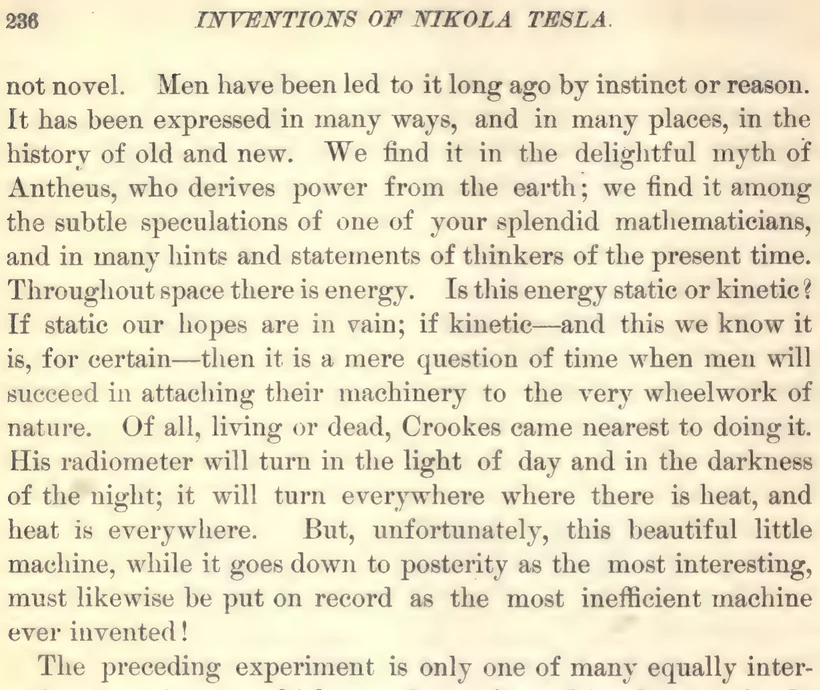
The version in circulation ends at 'nature', prints 'attach' for the page's 'attaching', and stops three sentences early. What follows names William Crookes, then the machine: "His radiometer will turn in the light of day and in the darkness of the night; it will turn everywhere where there is heat, and heat is everywhere" (1894, p. 236). Then the verdict: "this beautiful little machine, while it goes down to posterity as the most interesting, must likewise be put on record as the most inefficient machine ever invented" (1894, p. 236).
It is a conditional about kinetic energy, it names a radiometer, and it ends by calling the nearest thing to its own idea the worst machine ever invented. Then the paragraph breaks and the book says what the passage was for: the radiometer is one of many experiments that can be done on a single wire at high potential and high frequency (1894, p. 236). In the next paragraph he hedges the plan: impracticable in many cases it may look, but "certainly seems practicable, and even recommendable, in the production of light" (1894, p. 236).
What He Did Claim, and in Whose Voice
Two people wrote the pages this article quotes, and which of them is speaking changes what a sentence is worth. Chapters XXVI and XXVII are the printed texts of two lectures Tesla gave, in 1891 and 1892, and chapter XXXI is his own short paper on medical advertising: his words, in the first person. Everything it quotes from anywhere else is Thomas Commerford Martin's, the volume's editor, who calls himself its compiler on printed p. 6 and writes about Tesla in the third person. He writes in three postures: a biographical introduction (chapter I), a running review of the lectures (chapter XXV) that says he is writing one (1894, p. 119), and descriptive chapters about devices (chapters II and XXXVI). The efficiency figures cited below are in chapter II, not chapter I (1894, p. 8).
Energy From the Medium
In the 1891 Columbia lecture he settles the practical question first: "How far the results here borne out are capable of practical applications will be decided in the future" (1894, p. 196). Then the proposition: "there is a possibility of obtaining energy not only in the form of light, but motive power, and energy of any other form, in some more direct way from the medium" (1894, p. 196). A possibility about a method, with no machine, no output and no measurement in it. The sentence that gets quoted is on the next page and is a wish about humanity: "There must be some way of availing ourselves of this energy more directly" (1894, p. 197). He calls the supply a store forever inexhaustible, which is the only time that word appears in the volume (1894, p. 197). Nothing is demonstrated on either page.
One Wire
"A most curious feature of alternate currents of high frequencies and potentials is that they enable us to perform many experiments by the use of one wire only" (1894, p. 232). Experiments, at high frequency and high potential, on a bench. The prediction, thirty-five printed pages later, carries its condition inside the sentence: "if motors, lamps, or devices of any kind are perfected ... economical reasons will make it advisable to use only one wire" (1894, p. 267). The condition is a class of machine he did not have. What happened to the idea is in the site's article on one-wire power.
A Motor Grounded to the Earth
The compiler's, in chapter XXV, describing a rotating-field motor run from a single insulated line (1894, p. 138); the machine is the kind of motor the site's rotating-magnetic-field article is about. Then the claim: "Experiments of this kind seem to bring it within possibility to operate a motor at any point of the earth's surface from a central source, without any connection to the same except through the earth" (1894, p. 138). What follows is a chain of conditionals, none of them a build (1894, p. 138). Then the sentence that decides what is being claimed: "In this manner, even if it were not possible to operate machinery, intelligence might be transmitted quite certainly" (1894, p. 138). He gives up the machinery and keeps the signalling. The book's phrase is 'the earth's potential', and it occurs once, here. The same proposal, quoted in full and with its conditions left attached, is worked through on its own page at Tesla's Wireless Power Plan, In His Own Words (1893).
A Flame That Consumes No Material, in Someone Else's Words
In the 1891 lecture he writes that "we have a possible way of producing - by other than chemical means - a veritable flame, which would give light and heat without any material being consumed" (1894, p. 167), and the price, in the same sentence, is frequencies and potentials he did not have. Forty-seven printed pages earlier the compiler paraphrases the idea in his own words, and his version is the one that sounds like a free-energy claim: a flame "which consumes no material and in which no chemical action whatever takes place" (1894, p. 120). An article that quotes that with a p. 167 citation has invented a Tesla sentence. The rest of that argument is the site's cold-flame article's.
The Only Magnetic Generator in the Book Has a Fire Under It
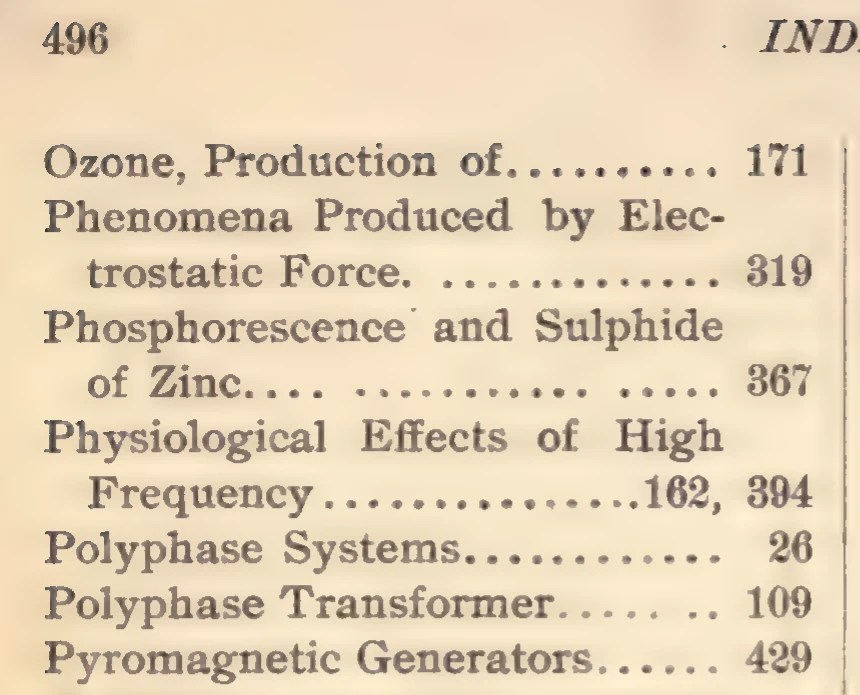
The volume indexes its own generator twice and both entries point at one page. Under G: "Generators, Pyromagnetic" (1894, p. 494). Under P: "Pyromagnetic Generators" (1894, p. 496). The page they give is printed p. 429, and the sentence there is the prose hit the count is about: "Mr. Tesla has also devoted his attention to the development of a pyromagnetic generator of electricity" (1894, p. 429). The compiler's footnote on the same page is a second hit there, which is why five hits and four pages are both true.
The machine works because heat destroys magnetism: the chapter credits that fact to William Gilbert, an iron bar heated to redness losing its magnetism (1894, p. 424). Its stated laws are ordinary induction plus that effect, and nothing in them is free. The page that states them illustrates the principle with words rather than with a drawing: "This principle of operation may be illustrated by a simple experiment" (1894, p. 429), a magnetized steel bar laid end to end with a strip of soft iron, a coil wound on the iron, and a flame raised until that part of the iron is "an orange red" (1894, p. 429). There is no illustration on that page at all, and the chapter's two drawings of the machine are on printed p. 430 instead. That page says what sits above the fire: "Above the fire is a boiler K, containing water" (1894, p. 430).
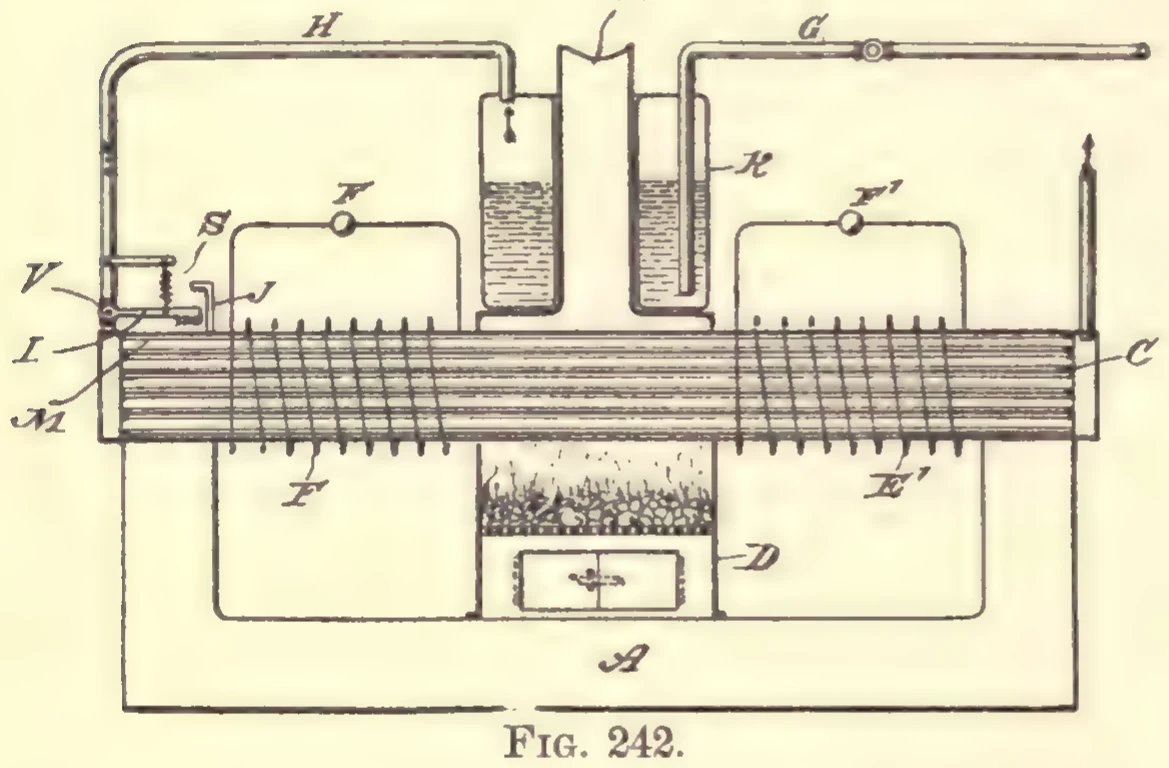
The compiler prints two judgements in that chapter, about different things, and they should not be merged. On the field of study: "since that time the influence of heat on the magnetic metals has been investigated frequently, though not with any material or practical result" (1894, p. 424). On how much attention Tesla gave it: "though he has but glanced at them" (1894, p. 424). Neither is a verdict on performance, because no performance is reported: over the chapter's eight printed pages 'test', 'per cent' and 'efficiency' are all 0, and 'output' is 1, a design property with no number on it. An absence of measurement is not a negative measurement. The book never says this machine failed, and this article does not either. What the book does say is that Tesla had "worked out one or two operative devices worthy of note" (1894, p. 424).
The only number in the chapter that reads like a rating is a vibration rate: the compiler heard about a demonstration in an interview with Tesla, a horseshoe magnet, an L of sheet iron and a spirit lamp, vibrating "as rapidly as 400 to 500 times a minute" (1894, p. 424). It is a footnote about a bench demonstration, not a rating of any machine the chapter describes. The only other number on those eight pages that states a quantity is a temperature, in the p. 429 experiment above: the page gives its heat as about 600 degrees centigrade, and says that at that temperature thin iron loses its magnetic properties (1894, p. 429). The site's list of nine inventions that did not catch on carries the same footnote for a different purpose.
What the Internet Gets Wrong
That the phrase is his. It is not in this book as a product name. 'magnet motor' 0, 'magnetic engine' 0, 'magnetic dynamo' 0, 'free electricity' 0, 'bifilar' 0, '512,340' 0, 'coil for electromagnets' 0. 'magnetic motor' is 3, and never stands alone: two of the three are 'Thermo-Magnetic Motors' in the editor's inventory and in the volume's own index (1894, pp. 6, 496), and the third sits in a line the OCR has scrambled, where 'electro' and 'magnetic motor' are split by two words that do not belong between them (1894, p. 46). None of the three is a bare 'magnetic motor'. That count is 3 on the text as it sits on disk and 4 on the index the quote checker builds, which joins 'electro-' to 'magnetic motors' across a line break at printed p. 55; the page prints 3 because that is what the printed volume contains, and the difference is the one the method section already names. Set a regex for a magnet word followed by a generator word and the volume returns 5, all of them 'pyro-magnetic generator(s)' or 'pyromagnetic generator(s)'. Reverse the order and the count is 0. It stays 0 unless the pattern lets a hyphen stand inside the magnet word, and then the single hit it produces is 'the generator iielcl-magnets' (1894, p. 35), where 'iielcl' is not a word. The site's review of what a Tesla magnetic generator is attributes the device to a patent number that does not appear in this book.
That the wheelwork sentence is a promise. It is a conditional that ends three sentences later in an insult about a machine's efficiency. The cut version is what circulates.
That 400 to 500 is a rating. It is the vibration rate of a bench demonstration the compiler says he heard about in an interview with Tesla, and the same footnote opens by saying the chapter's own machines vibrate 'very slow' (1894, p. 424). Print the number as a machine's rating and you have taken a footnote out of the page it sits on. It is one string in 174,169 words.
That he complained about free-energy hype. He did complain about being sold, and the page is about something else. In a two-page paper on high-frequency currents and the body, a trade article about medical advertising, he writes that "a serious worker cannot despise anything more than the misuse and abuse of electricity which we have frequent occasion to witness" (1894, p. 394). That is his position on electrical hype, not a remark about free energy; what he was and was not willing to warrant in that paper is in the site's article on Tesla's high-frequency 'massage'.
What This Site Sells, and What the 1894 Book Can Carry
Three pages here sell the device; the honest thing is to report what they claim in their own words. The review of whether one is worth buying attributes the device to a Tesla patent granted in 1894, and in its own list of drawbacks says such a machine is not truly 'free energy' and 'requires a prime mover'. The free-electricity page describes a design that 'keeps spinning as long as the magnets are in place'. The scam page says a device 'actually produces roughly 5 times more energy than it consumes'. Those are this site's claims, not Tesla's, and the reader is linked to them.
What the 1894 book supplies instead is measurement. Its top efficiency figure is 94 and 95 per cent, for larger motors on the three-wire system, and the same page names the tests it is citing: Prof. Anthony's, which it dates to the winter of 1887-8, and the 1889 Pittsburgh tests made by Tesla and Albert Schmid (1894, p. 8). The editor says why he printed such figures: they "are cited to show that the efficiency of the system has not had to wait until the present late day for any demonstration of its commercial usefulness" (1894, p. 8). A book that measures how little energy is wasted is not a book that promises something for nothing. The one claim a commercial page makes that the 1894 text can meet is the existence of a pyromagnetic generator, and the book's account of it is a firebox, a boiler and no test.
The useful thing here is not a set of zeros but a method: ask for the phrase, in the book, on the page; ask which index a count came from; ask who is writing, since a Victorian editor summarising a lecture is not the lecturer. The counts above were re-run by a script in this site's own tooling while this page was being written, and what that script returned is what this page prints. The method, the full counts table and the printed page of every hit are on a standing page of their own: Tesla 1894 Word Search, which prints the command so a reader can run it. The two questions behind this page, what a device is claimed to deliver and what has been measured, are worked through at Is the magnetic generator a scam?, Is a Tesla Magnetic Generator Worth It? and Free Electricity from Magnets.
Frequently Asked Questions
Did Tesla Invent Free Energy?
Nothing in the 1894 book supports the claim. A word search of its text layer returns 0 occurrences of 'free energy', 'free-energy', 'perpetual', 'over unity' and 'over-unity'. The closest sentence in the volume is a claim about a method, not a machine: 'there is a possibility of obtaining energy not only in the form of light, but motive power, and energy of any other form, in some more direct way from the medium' (1894, p. 196). On the same page he declines to say what any of it is worth in practice: 'How far the results here borne out are capable of practical applications will be decided in the future' (1894, p. 196). No device, no output, no measurement.
What Did Tesla Actually Say About Free Energy?
He said space is full of energy, and that a way of using it more directly ought to exist. 'Throughout space there is energy. Is this energy static or kinetic ? If static our hopes are in vain; if kinetic - and this we know it is, for certain - then it is a mere question of time when men will succeed in attaching their machinery to the very wheelwork of nature' (1894, p. 236). The next two sentences name the machine he has in mind, William Crookes' radiometer, and the same paragraph ends by putting it on record as 'the most inefficient machine ever invented' (1894, p. 236). The passage is a warning about efficiency, and the paragraph after it says what the passage was for: one-wire demonstrations.
Does the 1894 Book Mention Perpetual Motion?
No. 'perpetual' returns 0 hits, and so does the stem 'perpetu', so no inflected form either. The book does describe a generator that runs on heat: chapter XXXVI reports a pyromagnetic generator, and the volume's own index files it twice, under 'Generators, Pyromagnetic' (1894, p. 494) and 'Pyromagnetic Generators' (1894, p. 496), both pointing at printed p. 429. Over that chapter's own eight printed pages, 'test', 'per cent' and 'efficiency' all return 0. The chapter reports a design, an illustration and a boiler of water, and no measurement of the machine.
Is a Tesla Magnetic Generator a Real Thing?
Not in this book's vocabulary. 'magnetic generator' occurs 5 times in the 1894 volume, at printed pp. 6, 424, 429 twice and 496, and every one of those five sits inside 'pyro-magnetic' or 'pyromagnetic'. 'magnet motor', 'magnetic engine', 'magnetic dynamo', 'free electricity', 'bifilar' and the patent number '512,340' return 0 hits each. What the 1894 text describes is a heat engine whose magnetic circuit is opened and closed by heat: the page that names the generator also says 'Above the fire is a boiler K, containing water' (1894, p. 430). The phrase a shopper types today is a product name, and it belongs to this century.
The 1894 book measures what its machines wasted, and never once says a machine gives something for nothing. If you are sizing a real supply for a shed, a workshop or a small off-grid structure, the plans we recommend come with a parts list and a straight answer about output.
We earn a commission if you buy through that link. It does not change what the 1894 book says.
Sources
- The Inventions, Researches and Writings of Nikola Tesla, ed. Thomas Commerford Martin. New York: D. Van Nostrand, 1894 (entered 1893). Scan: archive.org item inventionsresear00martiala. Public domain.
- Chapter I, the editor's biographical introduction, printed pp. 3 to 6, and chapter II, his preface to the polyphase section, printed pp. 7 to 8. The inventory sentence and the date fence are printed p. 6, in chapter I; the efficiency figures are printed p. 8, in chapter II. The boundary is the volume's own: chapter II's heading is set at the top of printed p. 7. Both chapters are the editor writing about Tesla in the third person, not Tesla
- Chapter XXV, 'INTRODUCTION. - THE SCOPE OF THE TESLA LECTURES', printed pp. 119 to 144, which is the compiler's running review of three lectures and not Tesla's text. The one-wire summary at printed p. 137 and the grounded-motor passage at printed p. 138 are in it. The compiler labels his own chapter: 'We may now proceed to a running review of the lectures themselves' (1894, p. 119)
- Chapter XXVI, 'EXPERIMENTS WITH ALTERNATE CURRENTS OF VERY HIGH FREQUENCY AND THEIR APPLICATION TO METHODS OF ARTIFICIAL ILLUMINATION', printed pp. 145 to 197, the lecture delivered at Columbia College on May 20, 1891, dated by the chapter's own footnote: 'A lecture delivered before the American Institute of Electrical Engineers, at Columbia College, N. Y., May 20, 1891.' (1894, p. 145). The heading is quoted from the print of scan file 163, read at 500 ppi: on printed p. 145 the text layer interleaves the chapter number into the display heading and mis-sets three words, 'EXPEEIMENTS', 'WlTH' and 'HlGH', so the heading does not grep as one string there. The book's own contents pages list both lectures by title, with the dates and the opening pages this article cites; they are front matter and this article takes no page numbers from them. The flame passage is printed pp. 166 to 167. The energy-from-the-medium passage is printed pp. 196 to 197, which are this chapter's last two pages, not chapter XXVII's opening
- Chapter XXVII, 'EXPERIMENTS WITH ALTERNATE CURRENTS OF HIGH POTENTIAL AND HIGH FREQUENCY', printed pp. 198 to 293, the lecture delivered before the Institution of Electrical Engineers, London, February 1892, dated by its own footnote: 'Lecture delivered before the Institution of Electrical Engineers, London, February, 1892.' (1894, p. 198). The heading was read off the print at 500 ppi, scan file 216, because the text layer sets 'HlGH', a capital H with a lowercase L, for HIGH on that page, and 'CHAPTEE' for CHAPTER. The one-wire sentence is printed p. 232, the wheelwork passage is printed p. 236, and the one-wire prediction is printed p. 267
- Chapter XXXI, the paper on high-frequency currents and the body, printed pp. 394 to 395, from which the 'misuse and abuse of electricity' sentence is quoted here. That paper is about medical advertising, and this article uses it only as his general position on electrical hype. It runs two pages: printed p. 396 opens the next chapter. The paper itself is worked through in the site's article on Tesla's high-frequency 'massage'
- Chapter XXXVI, on thermo-magnetism and pyro-magnetism, printed pp. 424 to 431, which is the compiler's chapter about a device, with footnotes he says came from an interview with Tesla: 'In an interview with Mr. Tesla on this subject, the compiler learned of an experiment which will interest students' (1894, p. 424). The chapter's display heading is named in this article, not quoted as a string from the text layer: it is display type, the text layer interleaves the chapter number into it ('THERMO-MAGNETIC' then 'XXXVI.' then 'MOTORS AND PYRO-MAGNETIC GENERATORS.'), and the search index that strips running heads and display type does not contain it. The heading this article names was read off the print of scan file 442 at 500 ppi
- The volume's own index, printed pp. 494 and 496, for the two entries that file the machine under pyromagnetic
- The word search: books/extracted/tesla-1894-plain.txt, the text layer of our scan of archive.org item inventionsresear00martiala, whole volume, exact substring counts, case-insensitive, with printed page = scan file page minus 18. Re-run on 2026-10-18 by new_content/1894-series/10-tesla-free-energy-what-he-said/word_counts.py, which prints the counts three ways (raw text, the index books/tools/check_quotes.py builds, and that index with running heads and display type kept) and prints the counts scoped to printed pp. 424 to 431. The raw counts are the ones SERIES-PLAN-1894.md Appendix D prints, and they are the ones this page shows. The near-match fallback in books/tools/grep_quote.py is why no count on this page is taken from that tool's output
- The three pages on this site that the article reads, and whose own words it reports: 'Is The Magnetic Generator Just a Scam?', 'Is a Tesla Magnetic Generator Worth It? (2026 Review)' and 'Free Electricity From Magnets - Is It Possible?'. They are this site's current commercial pages, not sources about Tesla, and the article's rule is that it reports what they claim rather than repeating it
- The word-search page that publishes this method and these counts as a standing page: Tesla 1894 Word Search. It prints the command, both indexes and the printed page of every hit. Its counts and this article's are the same measurement of the same file; the link is here because that page now exists, and it was withheld from this list while it did not
- Every quote in this article was re-grepped and pinned to its printed page before drafting. The register is new_content/1894-series/10-tesla-free-energy-what-he-said/quotes.md, re-runnable with books/tools/grep_quote.py and regenerated by gen_quotes.py in that directory; it records 72 verified quotes, 26 rejected ones, and the flags this draft writes around
- Pages of the 1894 edition used here: p. 6, p. 8, p. 35, p. 46, p. 119, p. 120, p. 138, p. 167, p. 196, p. 197, p. 232, p. 236, p. 267, p. 394, p. 424, p. 429, p. 430, p. 494, p. 496