Tesla Lit Lamps by Holding Them: The 1891 Proof
The 1894 File · No. 1 of 12. Every quote below is cited from the first edition, page numbers included.
Published: October 19, 2026 | Updated: October 19, 2026
Standfirst. Nikola Tesla lit lamps by holding them, in New York in 1891 and in London in 1892, and the 1894 book prints both lectures. It also prints the tests he ran to decide what was actually happening. Those tests are better than the legend.
The Demonstration He Gave Twice
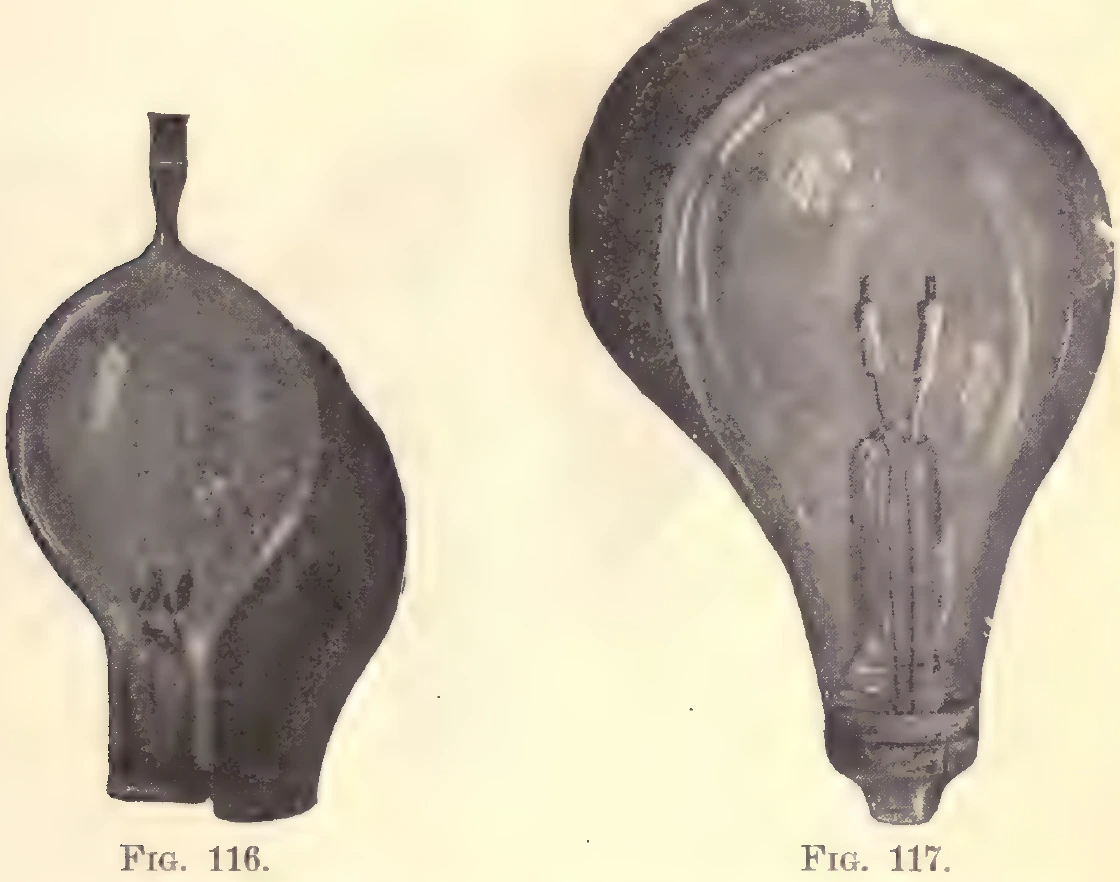
In February 1892 Nikola Tesla addressed the Institution of Electrical Engineers in London, and partway into the lecture he picked up a glass tube.
"Here is a simple glass tube from which the air has been partially exhausted. I take hold of it ; I bring my body in contact with a wire conveying alternating currents of high potential, and the tube in my hand is brilliantly lighted." (1894, p. 200)
Then the sentence that turns a curiosity into a demonstration: "In whatever position I may put it, wherever I move it in space, as far as I can reach, its soft, pleasing light persists with undiminished brightness." (1894, p. 200)
He followed it with a second piece of apparatus. "Here is an exhausted bulb suspended from a single wire. Standing on an insulated support, I grasp it, and a platinum button mounted in it is brought to vivid incandescence." (1894, p. 200)
None of this was news to that room. Nine months earlier he had given the same class of results to the American Institute of Electrical Engineers, at Columbia College in New York, on May 20, 1891 (1894, p. 145). That lecture is chapter XXVI of the book, the London one is chapter XXVII, and he refers back to the earlier paper in the first pages of the later: "A short time ago I had the honor to bring before our American Institute of Electrical Engineers some results then arrived at by me in a novel line of work." (1894, p. 199)
The 1891 text states the same effect without the stagecraft: "if a tube be taken in one hand, the observer being near the coil, it is brilliantly lighted and remains so no matter in what position it is held relatively to the observer's body" (1894, p. 185).
The claim is in print twice, with the apparatus described and the audience named. The interesting part is what he did next.
The Return Path Is the Room
A lamp needs a circuit. Every reader knows that, and it is why a one-terminal lamp sounds like conjuring. Tesla's answer is not that the rule is wrong. It is that the second side of the circuit can be the space around the apparatus.
"When a lamp is lighted by connecting it to one terminal only of the source, this may be facilitated by providing the globe with an outside condenser coating, which serves at the same time as a reflector, and connecting this to an insulated body of some size." (1894, p. 183)
Then the line that gives the game away: "In all cases the insulated body serves to give off the energy into the surrounding space, and is equivalent to a return wire." (1894, p. 184) He adds that "instead of connecting the wires to an insulated body, connections may be made to the ground" (1894, p. 184).
The numbers are in the same chapter. To drive energy through the wall of a glass lamp by electrostatic induction, "using currents alternating twenty thousand times a second, the potential required is approximately 9,000 volts" (1894, p. 183). Nine thousand volts, twenty thousand alternations a second, and no second wire. That is not mysticism. It is a transformer working outside the range where low-frequency wiring feels intuitive.
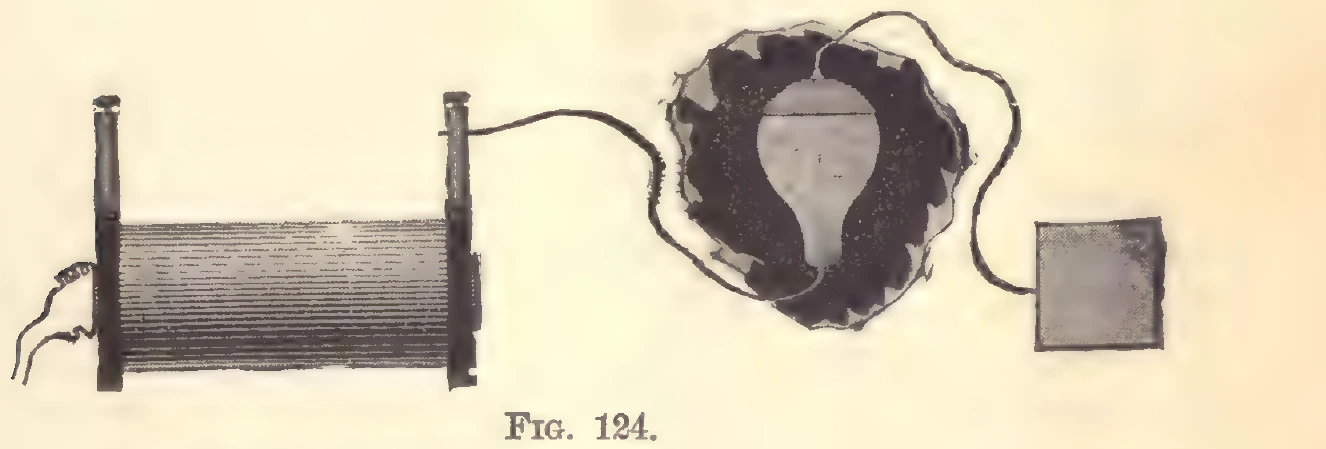
Fig. 124 is the plan of connection for exactly that lamp, and the book says the brightness is set by the size of the plate he hangs it in: "The brilliancy of the lamp may, in this case, be regulated within wide limits by varying the size of the insulated metal plate to which the coating is connected." (1894, p. 183) A dimmer made out of a sheet of metal.
He Could Wipe the Light Out With His Hand
The tests in chapter XXVI are worth reading because they are built to fail in one case and not the other.
If the tube were driven by electromagnetic induction, the body of the person holding it would get in the way. It does not: "Were the action electromagnetic, the tube could not be lighted when the observer's body is interposed between it and the coil" (1894, p. 185). At a distance a person can complete the effect instead of spoiling it. "the observer may, standing upon an insulated support between coil and tube, light the latter by approaching the hand to it ; or he may even render it luminous by simply stepping between it and the coil. This would be impossible with electro-magnetic induction, for the body of the observer would act as a screen." (1894, p. 186)
Then the effect an audience remembered: "the singular effect of wiping out the light of the tube may be produced by passing the hand quickly along the tube and at the same time withdrawing it gently from the coil, judging properly the distance so that the tube remains dark afterwards" (1894, p. 186).
He did not stop at the trick. He put plates in the way and watched. An insulated metal plate interposed along the axis of the coil usually makes the tube brighter. A plate connected to earth destroys it: "its interposition will always make the tube go out even if it be very near the coil" (1894, p. 187). A sheet of hard rubber also quenches it, because it "diminishes considerably the electrification through the air" (1894, p. 187).
And there is a null point. Held exactly over the centre of a coil wound in sections, the tube "may remain completely dark", and the reason is stated: "both halves of the coil neutralize each other, and the electric potential is zero" (1894, p. 185). Move it slightly to one side and it lights intensely. A phenomenon with a zero crossing is a measurable thing, not a marvel.
By the end of the section he is reading by this light: "tubes devoid of any electrodes may be used, and there is no difficulty in producing by their means sufficient light to read by" (1894, p. 187). In the 1892 lecture the same field drives small machines. A tube sealed around a filament and a tiny mica fan: "When the glass tube is held anywhere in the electrostatic field the platinum wire becomes incandescent, and the mica vanes are rotated very fast." (1894, p. 289)
Why He Opened and Closed With It
"Of all these phenomena observed with currents, or electric impulses, of high frequency, the most fascinating for an audience are certainly those which are noted in an electrostatic field acting through considerable distance; and the best an unskilled lecturer can do is to begin and finish with the exhibition of these singular effects." (1894, p. 288)
That is candour about lecture technique, and then, in the same paragraph, he reports something he could not explain. A tube with too high a vacuum will not light in the electrostatic field until it has been excited by a disruptive discharge coil, and it keeps the habit: "I may put it away for a few weeks or months, still it retains the faculty of being excited. What change have I produced in the tube in the act of exciting it?" (1894, p. 288) He weighs two explanations, motion imparted to atoms and strain in the dielectric, and says neither accounts for it. An exhausted tube that lights with nothing attached to it, and keeps the habit of lighting, is a subject the same book returns to, and that material is worked through on its own page at Glowing Glass in Tesla's Bare Hand.
One caution for anyone retelling these evenings. The book names the society, the venue and the date, and it does not give an audience size. Any headcount you find online was invented later.
What the Internet Gets Wrong
That the hand is the power source. It is not. The hand is one electrode, and the capacitance of a human body is why a hand makes a difference at all. The energy comes out of a machine, and Tesla's own phrasing is the cleanest statement of it: the insulated body "is equivalent to a return wire" (1894, p. 184).
That this proves energy from the aether, or free power. Tesla did write about the aether, and the book prints it: "The eternal recipient and transmitter of this infinite energy is the ether." (1894, p. 145) That is his account of what a field is. It is not the mechanism of the demonstration, and the demonstration does not depend on it. What the lamp chapters discuss is volts, frequencies, coatings and brightness. The phrase "free energy" does not appear anywhere in this volume; a word search of our copy of the text returns zero hits.
That the high voltage made the demonstration dangerous. The book says the opposite about the apparatus in use: "The physiological effects of the high tension discharge are found to be so small that the shock of the coil can be supported without any inconvenience, except perhaps a small burn produced by the discharge upon approaching the hand to one of the terminals." (1894, p. 125) That is one man's report about one high-frequency machine in 1891. It is not a safety instruction for anybody else, and none of this should be tried at home.
Where the Effect Survives
The lamps in these chapters lost. Electric lighting went another way, and the book is honest that they were laboratory lamps. Of the circuit in Fig. 126: "This plan has been used by me frequently for operating a few incandescent lamps required in the laboratory." (1894, p. 193)
What survived is the trick of using the surroundings as part of the circuit. High-voltage tube supplies still light a tube that is only partly connected, and touch sensors work because a person adds capacitance to a node. The mechanism is the one shown in Fig. 124: a high alternating potential on one terminal, and something large enough on the other to give that energy off into space.
The book carries the practical half of it too: generate the high tension, then step it down before anyone touches it.
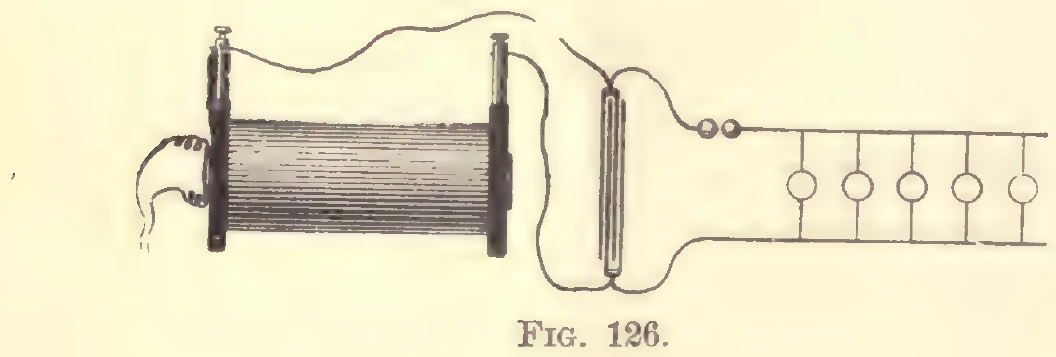
Fig. 126 shows "a plan of connections ... for converting currents of high, into currents of low, tension by means of the disruptive discharge of a condenser", and he notes that with the line earthed "all the wires could be handled with perfect impunity, no matter how high the potential at the terminals of the condenser" (1894, p. 193).
For the machine that made these effects available, see Tesla's high-frequency alternators, with the pole counts and the thirty thousand alternations a second. For the same effects on a much larger stage, see Tesla at the 1893 World's Fair. For the brush that forms at a single high-potential terminal, and for Tesla's argument that it is a flame even though it does not burn you, see The Flame That Doesn't Burn: Tesla's Cold Fire. To go the other way, from the physics back to a machine you can actually build, see how a magnetic dynamo generator puts out current and whether magnets can be used to generate electricity.
Frequently Asked Questions
How Did Tesla Light a Bulb Without Wires?
He connected it to one terminal of a high-potential, high-frequency source and used a large insulated body, often his own, as the other side of the circuit. The book states the principle plainly: 'In all cases the insulated body serves to give off the energy into the surrounding space, and is equivalent to a return wire' (p. 184). The tube then lights 'wherever I may hold it' (p. 200), and the brightness can be set by the size of the plate he connects to it (p. 183).
Was the Lamp in Hand Demonstration in 1891 or 1892?
Both, and the book prints both lectures. Tesla described this work to the American Institute of Electrical Engineers at Columbia College, New York, on May 20, 1891 (p. 145, footnote to the opening of chapter XXVI). He returned to it before the Institution of Electrical Engineers in London in February 1892 (p. 198, footnote to chapter XXVII). The famous wording, 'the tube in my hand is brilliantly lighted', is from the London lecture (p. 200); the laboratory version of the same test is in the 1891 text (p. 185).
Why Did the Tube Go Dark When He Passed His Hand Along It?
Because his hand changes the electrification of the tube, not because it blocks a beam. Holding a lit tube with the other hand makes the part between the hands dark, and the book describes 'the singular effect of wiping out the light of the tube' by moving the hand along it while drawing the tube away from the coil (p. 186). In the same chapter a metal plate connected to earth puts the tube out even close to the coil (p. 187).
Is This the Same Thing As Wireless Power Transmission?
No. These are near-field effects: a high alternating potential is put on one terminal, and the surroundings carry the return (pp. 183 to 187). Tesla's argument for distributing power on a single conductor is a separate one, made later in the 1892 lecture, where he writes that such currents 'enable us to perform many experiments by the use of one wire only' (p. 232). A glowing tube in the hand proves the first, not the second.
A lamp that lights from one terminal is a lesson in high-voltage engineering, not in free power. If you are looking at a home generator instead, the plans we recommend come with a parts list and a straight answer about output.
We earn a commission if you buy through that link. It does not change what the 1894 book says.
Sources
- The Inventions, Researches and Writings of Nikola Tesla, ed. Thomas Commerford Martin. New York: D. Van Nostrand, 1894 (entered 1893). Scan: archive.org item inventionsresear00martiala. Public domain.
- Chapter XXVI, 'Experiments with Alternate Currents of Very High Frequency and Their Application to Methods of Artificial Illumination', a lecture delivered before the American Institute of Electrical Engineers at Columbia College, N. Y., May 20, 1891; printed pp. 145 to 197 of the 1894 edition
- Chapter XXVII, 'Experiments with Alternate Currents of High Potential and High Frequency', a lecture delivered before the Institution of Electrical Engineers, London, February 1892; printed pp. 198 to 293 of the 1894 edition
- Chapter XXV, on the physiological effect of the high-tension discharge, printed p. 125 of the 1894 edition
- Word search of the full text of this edition for 'free energy': 0 occurrences. Method and counts are recorded in books/extracted/tesla-1894-plain.txt and re-run by books/tools/grep_quote.py
- Pages of the 1894 edition used here: p. 125, p. 145, p. 179, p. 182, p. 183, p. 184, p. 185, p. 186, p. 187, p. 192, p. 193, p. 198, p. 199, p. 200, p. 288, p. 289