The 1894 File: Tesla's First Big Book, Page by Page
Published: October 12, 2026 | Updated: October 12, 2026
Standfirst. This site is about building things. So we did the unglamorous part: we obtained a full scan of the 1894 first edition of Nikola Tesla's biggest book, took the text layer that comes with it, checked that layer against the page images, and read it. Twelve articles come out of that work. Each one cites the page it came from, and each one shows an engraving from that page at a size you can actually read.
What This Book Is
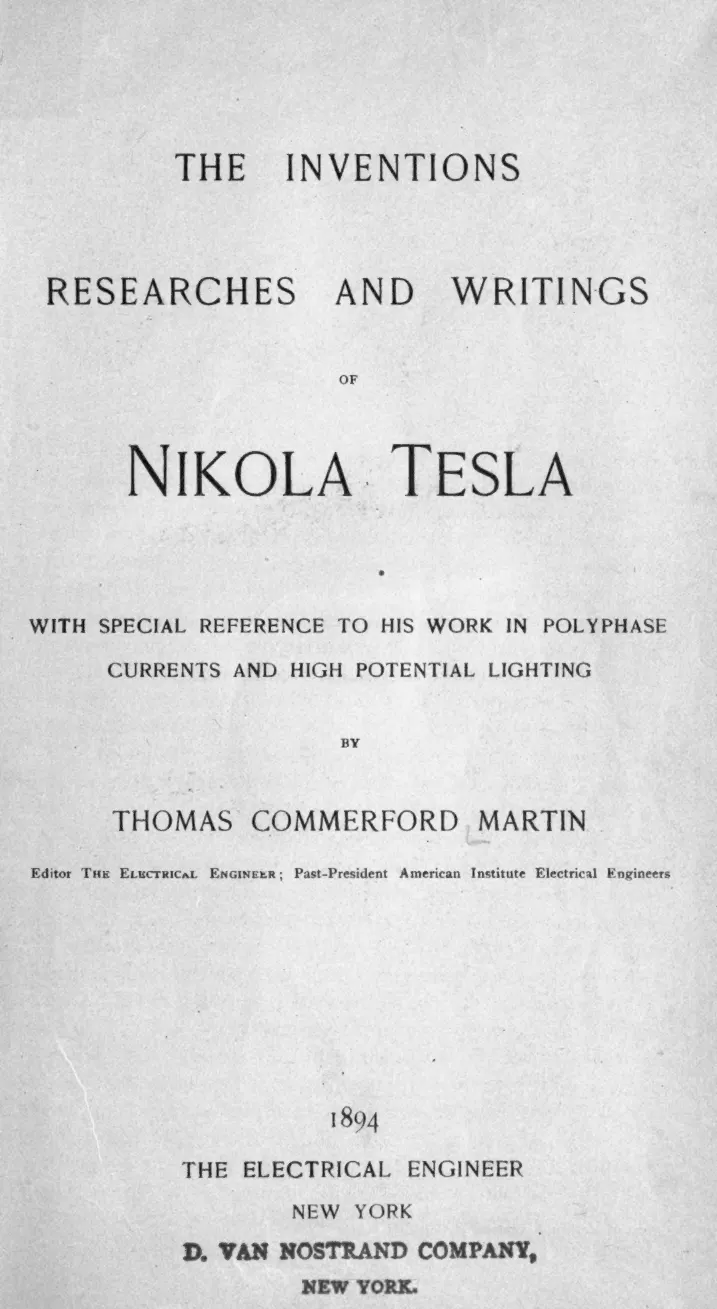
The volume is The Inventions, Researches and Writings of Nikola Tesla, with Special Reference to His Work in Polyphase Currents and High Potential Lighting, edited by Thomas Commerford Martin and published in New York by D. Van Nostrand in 1894. The copyright page says it was entered according to Act of Congress in 1893 by T. C. Martin, and names the printers, Press of McIlroy & Emmet, 36 Cortlandt St., which is why library records disagree about the date. We say printed 1894, entered 1893, and cite the front matter scans (files 9 and 10) when it matters.
Martin is not a footnote here. The title page describes him as editor of The Electrical Engineer and a past-president of the American Institute of Electrical Engineers, and the book opens with a dedication "to his countrymen in Eastern Europe" (front matter, scan file 6). He had seen the motors running. He wrote, of the paper at the centre of the whole story, that it "was written the night previous to the meeting, in pencil, very hastily, and under the pressure just mentioned" (1894, p. 9).
That is the kind of sentence you only get from a primary source, and it is the reason this series exists.
Why a Series Built on One Book
Most English-language writing about Tesla's high-frequency work paraphrases his lectures. The paraphrase is fine; it is just three handoffs away from the man. We hold the scan, the text layer and the page numbers, and we can put the original engraving next to the paragraph it belongs to.
The promise is narrow and checkable: every claim carries a page number from an 1894 book, and every article shows an engraving nobody else is showing.
We are not publishing the book itself. It is 35 MB of scans and it is already on the internet, hosted by the Internet Archive under the item name inventionsresear00martiala. Go there if you want the whole thing; we link it from every article.
The Twelve Articles
- Tesla lit lamps by holding them: the 1891 stage demonstration, in his words.
- One-wire power: why an insulated body "is equivalent to a return wire" (1894, p. 184).
- The earthquake machine: what the 1893 record says, and what it does not.
- Wireless power, in his own words: the 1893 version of the idea.
- High frequency massage: the "patent medicine" complaint, 1892 (1894, p. 394).
- The cold flame: "is it the less a flame because it does not scorch my hand?" (1894, p. 258).
- The rotating magnetic field: the May 1888 paper and the machines that reached 95 per cent.
- Tesla's weirdest inventions: from the book's own third part.
- Tesla at the World's Fair: 1893, with the plates.
- Tesla on free energy: the quote everyone cuts off.
- 30,000 alternations per second: the machine behind the demos.
- Glowing tubes: vacuum tubes, before tubes.
Two More Pages From the Same Scan
The book's illustrations are catalogued on their own page, Tesla 1894 Plates: 72 engravings and photographs from this scan, each cited to the printed page it sits on and numbered as the book numbers it. The word search behind the next two sections is a page of its own too, Tesla 1894 Word Search, which prints the command, the counts and the printed page of every hit.
How We Cite, and How We Could Be Wrong
Three rules, stated up front so you can check us.
The Page Offset
The scan files are numbered from the first page of the PDF, not from the printed page. In this volume the printed page number is always the scan file number minus eighteen. A citation of "(1894, p. 486)" means the page a reader of the physical book would turn to, and we work it out by subtracting eighteen from the file we opened. Front matter has no printed numbers, so we cite those by scan file instead.
The OCR
Machine reading of an 1894 page is not a transcript. Long-s renders as s, the digit 8 sometimes renders as S, and running headers get glued into the middle of sentences. We silently fix only the two mechanical artefacts, long-s and the S-for-8 digit swap, and mark anything else odd with [sic]. Every quotation is re-grepped from the text layer at writing time and pinned to a page before it ships. If you spot a quote we got wrong, tell us; it is the failure mode we worry about most.
The Captions Are Not Trustworthy
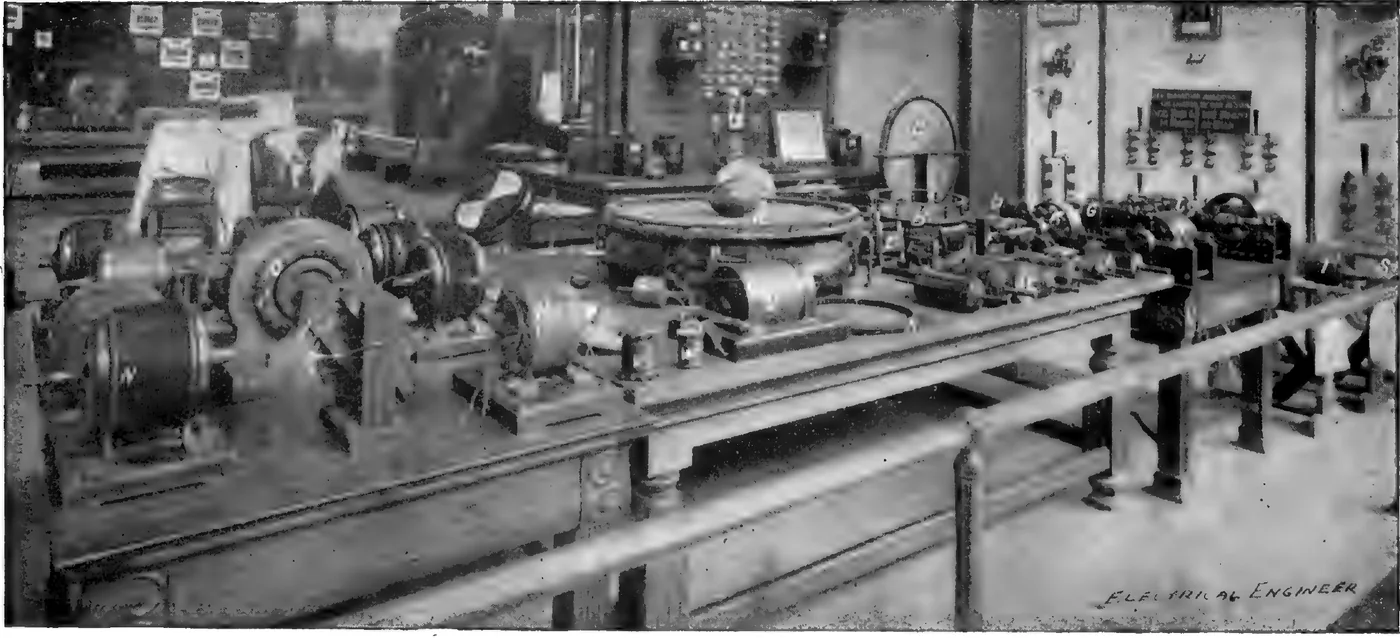
The book's own figure captions were machine-read too, and sometimes badly. One engraving in the World's Fair chapter came out of the OCR captioned "Fig. 811" (1894, p. 484), a figure number that does not exist in a book whose illustrations stop in the 300s. We look at every crop before we use it, and if the picture does not match the paragraph, we replace the picture rather than rewrite the caption.
The Word Search
A count is a rule before it is a number, so every count in this series says which text it was taken from and how the phrase was matched: whole word or substring, and whether running heads, bare page numbers and short display lines were kept or dropped. In this volume that distinction is not pedantry. The string 'magnetic generator' occurs five times over the page text as it sits in the file, and four times once the running heads and display lines are dropped, because one of the five is the title of a chapter. Both numbers are correct of the text each was taken from, which is why neither is printed without saying which index it came from. The method, the counts for every term this series has searched, and the printed page of every hit are on Tesla 1894 Word Search.
What the Book Does Not Say
We searched the whole volume the way you would with a printed book and a pencil. The phrases "free energy", "free-energy", "perpetual" and "over unity" appear zero times, whole word and as a substring, in both indexes. The string 'magnetic generator' occurs five times and never once as a phrase standing on its own: every occurrence sits inside 'pyro-magnetic generator' or 'pyromagnetic generator', a device driven by heat changes in magnetised steel, discussed at (1894, p. 429) and indexed at (1894, p. 496). Two of the five are running text, one is the title of chapter XXXVI, one is the editors' preface listing what the volume contains, and one is the book's own index entry.
That is a fact about an 1894 book, not a verdict on anyone's buying decision. But it is the fact we started from, and the full word-search method is written up at Tesla's 1894 word search.
If You Came Here for the Generator
The 1894 book never uses the phrase "Tesla magnetic generator", and nothing in this series claims a magnet motor will run your house. What the book does contain is a man describing machines he had built: motors at 94 and 95 per cent efficiency, an alternator at 30,000 alternations a second, an oscillator that tore a steel shaft in half.
If you want the practical end of this, start with what a magnetic generator actually costs. Read the history first, because it makes the sales talk much easier to place.
Frequently Asked Questions
What Book Is This Series Built On?
The Inventions, Researches and Writings of Nikola Tesla, with Special Reference to His Work in Polyphase Currents and High Potential Lighting, edited by Thomas Commerford Martin and published in New York by D. Van Nostrand in 1894. Its copyright page says the work was entered in 1893, which is why library records disagree about the date. The volume is in the public domain and a full scan of it sits on archive.org under the item name inventionsresear00martiala. Every page in this series works from that scan.
How Do You Get a Page Number Out of a Scan?
The scan files are numbered from the first page of the file, and the book's own numbering starts later than that, so in this volume the printed page is always the scan file number minus eighteen. A citation of (1894, p. 429) means page 429 of the physical book, not the 429th image. Front matter carries no printed numbers, so those pages are cited by scan file instead. The offset is measured rather than assumed: 402 body pages carry a readable folio in the text layer, 367 of them agree with the rule, and the other 35 are misread folios rather than a different pagination.
Do You Correct the OCR?
Two mechanical artefacts, silently: the long-s that an 1894 page sets where a modern reader expects s, and the capital S that a text layer sometimes reads as the digit 8. Anything else the text layer gets wrong is either quoted as it is with [sic], or settled against the page image at high resolution, and the page says which one was read. Every quotation on this site is re-grepped from the text layer and pinned to a printed page before the page that quotes it ships.
Can I Read the Book Itself Here?
Not on this site. There is no PDF to download and no scan hosted here: the full volume is already on archive.org, and it is better there than copied here. What this site adds is the reading work. The engravings from that scan are shown one at a time and cited to the printed page each one sits on, the text is searchable and counted with the counting rule stated, and every claim on every page carries the page number it came from.
The 1894 book is history. If you want something you can actually build this weekend, the plans we recommend are based on Tesla's work, and we tell you honestly what to expect.
We earn a commission if you buy through that link. It does not change what the 1894 book says.
Sources
- The Inventions, Researches and Writings of Nikola Tesla, ed. Thomas Commerford Martin. New York: D. Van Nostrand, 1894 (entered 1893). Scan: archive.org item inventionsresear00martiala. Public domain.
- World's Fair / Electrical Congress reporting, and the chapter map in Appendix B of our working notes
- Pages of the 1894 edition used here: p. 236, p. 484, p. 496