9 Tesla Inventions From 1894 That Never Caught On
The 1894 File · No. 8 of 12. Every quote below is cited from the first edition, page numbers included.
Published: October 24, 2026 | Updated: October 24, 2026
Standfirst. Nine devices, each cited to the printed page of the 1894 book that collected them. The volume never says any of them failed, and for most of the nine it says nothing at all about what became of them. What it does record, entry by entry, is the thing each machine needed and had not got: a rotating armature turning in step with the line, a dielectric with no gas in it, a current that had to be reversed after every reading.
Before the Entries: Whose Words These Are
Nine devices, all from Part III of the 1894 volume, the part its editor titles 'MISCELLANEOUS INVENTIONS AND WRITINGS'. He announces it in his own inventory of the book, printed p. 6: "Mr. Tesla's work ranges far beyond" (1894, p. 6) the polyphase work the rest of the volume is about, and names the section's contents: arc lighting, pyro-magnetic generators, thermo-magnetic motors, third-brush regulation, improvements in dynamos, electrical meters, condensers, unipolar dynamos. That sentence, not any editorial choice of ours, is why this list has nine entries.
Whose words these are changes halfway through. Eight of the nine chapters are the editor writing about his subject in the third person, start to finish, entries 7 and 8 included; on the six that run from printed p. 409 to p. 447 the tells are plain: 'Mr. Tesla divides such circuit' (1894, p. 409), 'attributable to Mr. Tesla' (1894, p. 420). The ninth chapter is the exception, and the book says so. From the middle of printed p. 467 the compiler hands the chapter over - "It is thought appropriate by the compiler to append here some notes on unipolar dynamos, written by Mr. Tesla, on a recent occasion" (1894, p. 467) - and the footnote on that page dates it: "Article by Mr. Tesla, contributed to The Electrical Engineer, N. Y., Sept. 2, 1891" (1894, p. 467). Entry 6 borrows a sentence from a chapter that is his own, where he writes of himself in the third person. Every quotation mark below is the print's; every page number is the printed folio. The three headings that follow keep the book's order - chapters XXXIII to XXXV, XXXVI to XXXVIII, XXXIX to XLI - three chapters at a time.
Currents, Condensers and Meters
1. Direct Current From Alternating Current
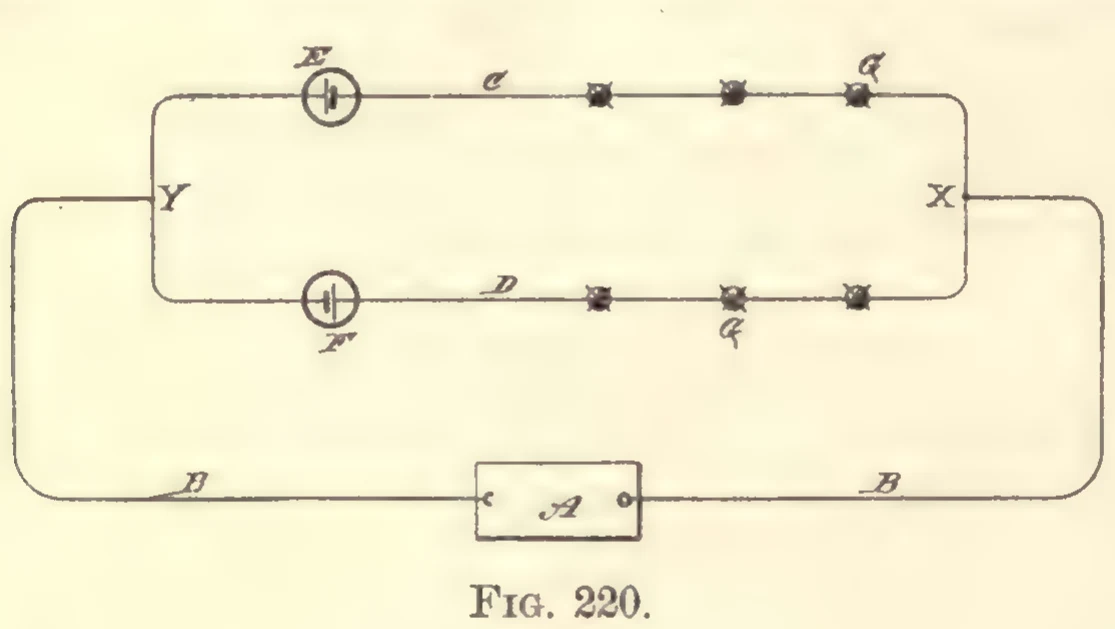
Chapter XXXIII splits an alternating circuit "at any desired point into two branches or paths" (1894, p. 409). One branch opposes one sign of the wave, the other the opposite sign, so the two halves go different ways. What comes out is "two or more direct currents without the employment of any commutator" (1894, p. 409). Not needing a commutator is the claim.
The volume never says the scheme failed. What it says three times, of three machines, is that they must turn in step with the supply: "the rotation and action of the commutator must be in synchronism ... with the periods of the alternations" (1894, p. 412). That is the difficulty: a rotating part tied to the line frequency. Conversion later went to static devices, and the last rotary converters feeding New York direct current were shut down in 1977 and replaced by solid-state rectifier units (Blalock, 2013).
2. Condensers With the Plates in Oil
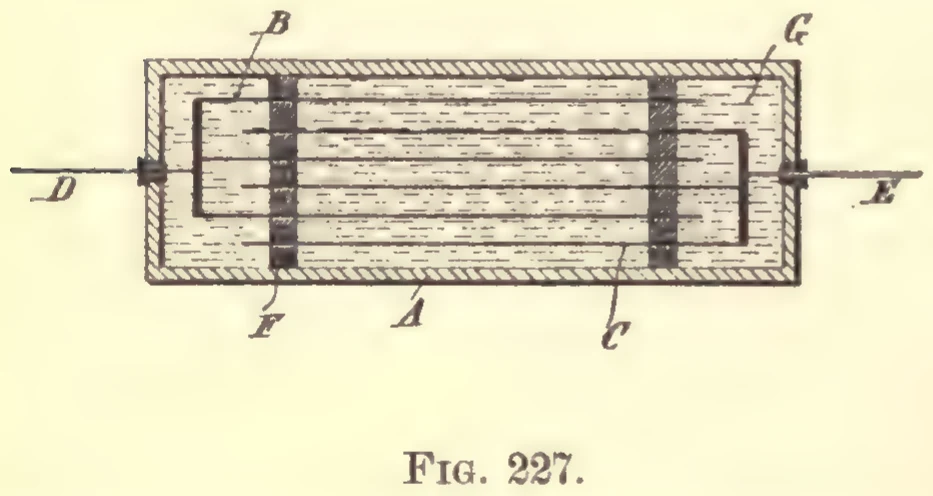
In high-frequency, high-potential apparatus the expected insulators are wrong: glass and mica, the bodies with the highest specific inductive capacity, are "inferior as insulators" (1894, p. 418). The reason is gas. It is "very desirable to exclude all gaseous matter from the apparatus" (1894, p. 418), because molecular bombardment in it wastes energy and injures the device. The device is a can. Its plates are held apart by porous strips "used merely for the purpose of maintaining them in position" (1894, p. 419): the oil is the dielectric. The book hedges its own novelty: oil between conductors "has been a common practice" (1894, p. 419). That hedge is why this entry did not lose. Vacuum oil impregnation is still how high-voltage paper insulation is made, because oil leaves no voids; oil-impregnated bushings hold more than 80 percent of that market (Jonsson and Johansson, 2009). Nobody builds the 1894 form.
3. Electrolytic Registering Meter
Chapter XXXV opens with "an ingenious form of electrolytic meter attributable to Mr. Tesla" (1894, p. 420): metal is plated onto one conductor and stripped from the other until "the electrical resistance of the conductor is varied in a definite proportion to the strength of the current" (1894, p. 420). The unit is the lamp-hour: the book measures "the increase of resistance of one conductor or the diminution of the resistance of the other per lamp hour" (1894, p. 422). Then the fatal step, in the same chapter: after every registration the current must be reversed, "so that the deposit will be taken from the conductor which has gained and added to that which has lost" (1894, p. 423). The editor's own verdict on the whole class closes the chapter: such meters "seem to need every auxiliary advantage to make them permanently popular and successful" (1894, p. 423).
Heat, Brushes and Regulation
4. Thermo-Magnetic Motor and Pyromagnetic Generator
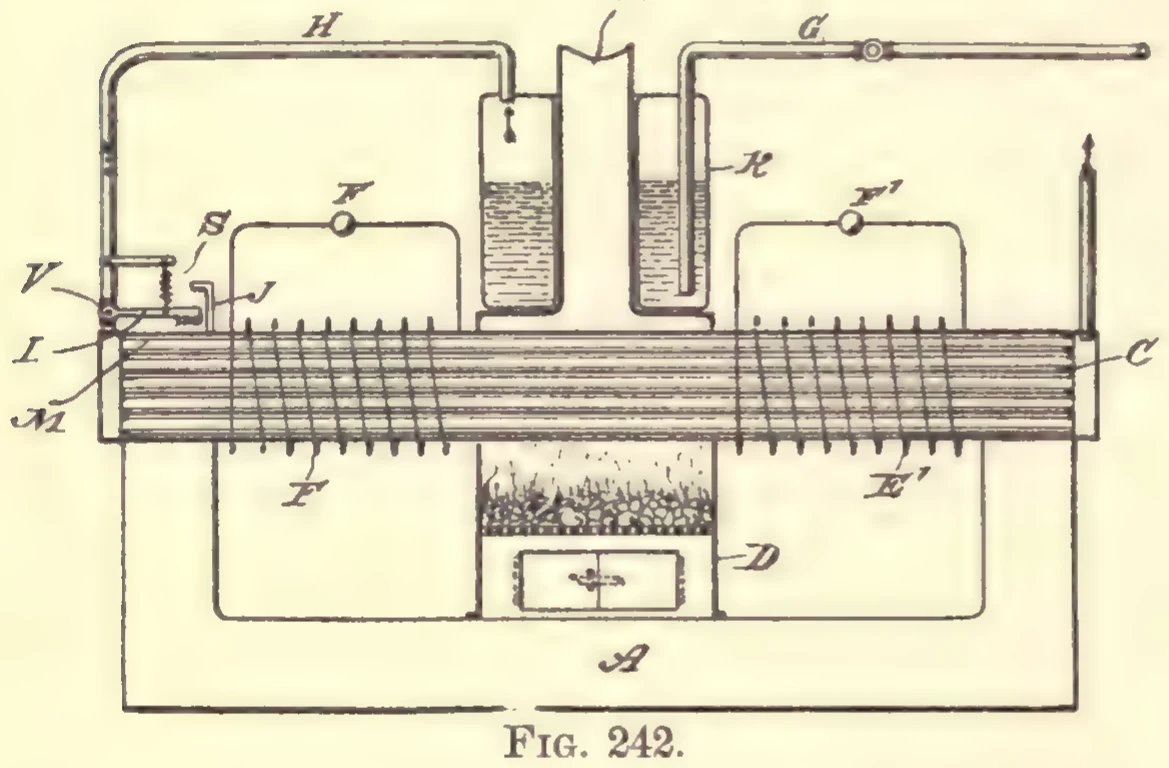
Heat destroys magnetism: an iron bar "when heated to redness loses its magnetism" (1894, p. 424). Tesla's thermo-magnetic motor runs on that: a burner heats an armature that a magnet pulls. The pyromagnetic generator puts the same effect to work in a coil (1894, p. 429). The compiler's own hedge on how far the work went: "he has but glanced at them" (1894, p. 424).
The spirit lamp and the L-shaped iron strip are a bench experiment, not the machine: the compiler heard of it in an interview with Tesla, and the strip vibrates against a horseshoe magnet "as rapidly as 400 to 500 times a minute" (1894, p. 424). The same footnote gives the limit - vibration is "very slow owing to the inability of the iron to follow rapid changes in temperature" (1894, p. 424). Neither machine is reported built, run or measured, and no efficiency figure appears in printed pp. 424 to 431.
5. Anti-Sparking Brush and Commutator
The fault is a generator's, not a motor's. In "direct current dynamos of great electromotive force - such, for instance, as those used for arc lighting" a spark appears when a commutator bar leaves the brush (1894, p. 432). The book calls the older fixes "expensive or not fully available" (1894, p. 432). Tesla's first device was mica or asbestos behind the brush, dated only as "some years ago" (1894, p. 432). His second was two matched discs, commutator and collector built alike, so the short circuit and the break "occur at the same instant" (1894, p. 434). The claim is hedged: it promises "a reduction which amounts practically to a suppression of the spark" (1894, p. 434). The insulating segments are stone: "glass, marble, or soapstone" (1894, p. 436). The last version has liquid mercury for segments (1894, p. 437). Neither is reported tested or run in printed pp. 432 to 437.
6. Auxiliary-Brush Regulation of Direct Current Dynamos
Chapter XXXVIII is the only one of the six chapters entries 1 to 6 come from that gives a device a year: "devised by him as far back as 1885" (1894, p. 438). No other year appears in them. The regulator adds a third brush on the commutator, bridged to a point on the field winding. Move it and "more or less of the current through the field-helices is diverted through the shunt" (1894, p. 438); set it right and, on the book's own rule, the brush carries no current at normal load (1894, p. 441).
The priority claim is his own, in another chapter, on high-frequency alternators, where he writes of himself in the third person: "as far as records go, he seems to have been the first who has successfully regulated machines ... by means of a third brush" (1894, p. 390). Chapter XXXVIII reports no installation, load test or result for the regulator.
Frames, Lamps and Discs
7. One Frame Pattern, Cast in Two Identical Halves
Chapter XXXIX is three printed pages, one device, and no story. "The field magnets and frame are cast in two parts. These parts are identical in size and shape" (1894, p. 448): one pattern, two halves, bearings cast in with the frame. The claim is manufacture, not performance: the machine "requires fewer parts, and which involves less trouble and expense in its manufacture" (1894, p. 448).
The one technical reason is a bearing placement: "The bearings for the shaft are located at the neutral points of the field, so that the armature core is not affected by the magnetic condition of the field" (1894, p. 450). The book prefaces that with "This machine possesses several advantages" (1894, p. 450) and supplies exactly one. Nothing in printed pp. 448 to 450 says the frame was built or tried, and no date or patent number appears in it. The frame suits machines 'of the ordinary type generally used' (1894, p. 448): the least Tesla-shaped of the nine.
8. Tesla's Direct Current Arc Lighting System
Chapter XL is the only one that says what became of the device. Tesla's direct current arc lighting system "was confided to a company formed for its exploitation"; he then turned to what the compiler calls his 'more celebrated' "rotary field" system (1894, p. 451), set out in the paper Tesla scribbled in pencil. The company is never named. The book's reason it did not win: a crowded market and a compliment. The apparatus "appeared at a time when a great many other lamps and machines were in the market" (1894, p. 451).
The lamp is the clever half: two electro-magnets pull against each other on the carbon-feed lever. The feed is so fine that "the movement of the rod cannot be detected without some actual measurement" (1894, p. 463): the book prints no measurement. Its last claim: "the lamp cuts itself out automatically when the arc gets too long" (1894, p. 464). The chapter reports no installation, load test or result.
9. Discs That Make Direct Current Without a Commutator
A unipolar machine is a disc turned between the poles of an even field; its current runs from centre to rim, "of one direction without the employment of commutating devices" (1894, p. 468). A useful voltage needs very high speed or a very large disc, and at either "it becomes difficult to secure and maintain a good electrical connection between the collecting brushes and the conductor, owing to the high peripheral speed" (1894, p. 465).
The rest of the chapter is Tesla's own writing. His answer: "a flexible conducting belt may be employed to advantage" (1894, p. 474). Then the one sentence in this list that reports a machine built and run: "Several machines with belt contact were constructed by the writer two years ago, and worked satisfactorily ; but for want of time the work in that direction has been temporarily suspended" (1894, p. 474). The book dates those notes to Sept. 2, 1891 (1894, p. 467), so 'two years ago' means about 1889 - our arithmetic, not the volume's.
The Only Magnetic Generator in This Book
Entry 4 is the one that concerns this site. Search the text layer of our copy of the volume for 'magnetic gener': four hits on three printed pages, one page carrying two - the editor's inventory (1894, p. 6), the chapter text at printed p. 429, and the volume's own index entry "Pyromagnetic Generators" (1894, p. 496), which points back to p. 429. Every one is pyro-magnetic. There is no other. The generator this book attaches that phrase to is entry 4's machine: one that works because heat destroys magnetism, with a flame under it, in a chapter that reports no output, no efficiency figure and no trial.
The pages here about magnet motors and perpetual motion are the Tesla magnet motor and perpetual motion machines. Neither cites this book, and nothing on this page is evidence for what they sell. What this page can say is narrower: the only magnetic generator in the 1894 volume is a heat engine, and none of the nine machines here is one either. What the same volume does say about energy, and the phrase it never prints, is worked through at What Tesla Actually Wrote About Free Energy.
The book never says these nine failed. For seven of them it records no trial, no output and no result. For two it records something else: entry 2's principle is still how high-voltage paper insulation is made, and entry 9's machines "worked satisfactorily" until their inventor ran out of time (1894, p. 474).
Seven of these nine are described in full and measured nowhere in the book: no output, no efficiency, no trial. Ask the same question of anything you are buying, and get the answer in writing. The plans we recommend come with a parts list and a straight answer about output.
We earn a commission if you buy through that link. It does not change what the 1894 book says.
Sources
- The Inventions, Researches and Writings of Nikola Tesla, ed. Thomas Commerford Martin. New York: D. Van Nostrand, 1894 (entered 1893). Scan: archive.org item inventionsresear00martiala. Public domain.
- Chapter XXXIII, 'METHOD OF OBTAINING DIRECT FROM ALTERNATING CURRENTS', printed pp. 409 to 417 (scan files 427 to 435). Entry 1 and the provenance quote 'Mr. Tesla divides such circuit at any desired point into two branches or paths' are from it. The chapter is the volume's editor writing about Tesla in the third person, not Tesla's writing
- Chapter XXXIV, 'CONDENSERS WITH PLATES IN OIL', printed pp. 418 to 419 (scan files 436 to 437). Entry 2, including the editor's own footnote on printed p. 418, which is quoted in the register and not used in this draft
- Chapter XXXV, 'ELECTROLYTIC REGISTERING METER', printed pp. 420 to 423 (scan files 438 to 441). Entry 3, including the editor's verdict on electrolytic meters at printed p. 423
- Chapter XXXVI, 'THERMO-MAGNETIC MOTORS AND PYRO-MAGNETIC GENERATORS', printed pp. 424 to 431 (scan files 442 to 449). Entry 4. The 400-to-500-a-minute number is in the compiler's footnote on printed p. 424, about a horseshoe-magnet bench experiment he says he learned of in an interview with Tesla, and the same footnote says the chapter's own devices vibrate 'very slow'; the draft prints the number only as that footnote prints it
- Chapter XXXVII, 'ANTI-SPARKING BRUSH AND COMMUTATOR', printed pp. 432 to 437 (scan files 450 to 455). Entry 5. The chapter gives no year for either device, only 'some years ago' and 'A few years later', and prints no patent number anywhere in it
- Chapter XXXVIII, 'AUXILIARY BRUSH REGULATION OF DIRECT CURRENT DYNAMOS', printed pp. 438 to 447 (scan files 456 to 465). Entry 6, including 'devised by him as far back as 1885' at printed p. 438, which is the compiler's date and not Tesla's
- Chapter XXXIX, 'IMPROVEMENT IN THE CONSTRUCTION OF DYNAMOS AND MOTORS', printed pp. 448 to 450 (scan files 466 to 468). Entry 7. The chapter prints no date, no patent number, no trial and no result; its one stated advantage is the bearing placement at printed p. 450, behind the sentence 'This machine possesses several advantages', and it closes by widening the claim to machines of the ordinary type generally used
- Chapter XL, 'DIRECT CURRENT ARC LIGHTING SYSTEM', printed pp. 451 to 464 (scan files 469 to 482). Entry 8, including the three sentences at printed p. 451 that make it the only one of the nine with a stated fate: the system 'was confided to a company formed for its exploitation', Tesla then turned to what the compiler calls his 'more celebrated' rotary field system, and the apparatus appeared at a time when many other lamps and machines were in the market. The company is not named anywhere in the chapter. The chapter heading as the scan reads it is 'TKSLA XI,' and 'SYSTKM', which is 'XL' and 'SYSTEM' misread; the chapter number is taken from the chapter order, not from that line
- Chapter XLI, 'IMPROVEMENT IN UNIPOLAR GENERATORS' (the printed heading sets UNIPOLAR inside quotation marks), printed pp. 465 to 474 (scan files 483 to 492). Entry 9. Printed pp. 465 to 466 and the top of 467 are the compiler; from the middle of printed p. 467 to the foot of p. 474 the chapter is Tesla's own writing, and the compiler says so in the text and dates it in the footnote ('Article by Mr. Tesla, contributed to The Electrical Engineer, N. Y., Sept. 2, 1891'). Entry 9's 'two years ago' is inside that reprinted article, so the date it points to is derived from the volume's own date-stamp and is not stated by the volume
- Chapter XXIX, the author's own account of high-frequency alternating-current generators, printed pp. 374 to 391 (scan files 392 to 409). NOT Part III: it is the author writing about himself in the third person. Entry 6's priority claim at printed p. 390 is his own sentence with his own hedges in it. Article 11 (feature-007) is built on this same chapter and says nothing about the voice, so the two pages do not contradict each other today; if either page ever describes that voice, both must be checked together
- Thomas J. Blalock, 'The Rotary Era, Part 2: Early AC-to-DC Power Conversion, Continued', IEEE Power and Energy Magazine, November/December 2013, for the modern half of entry 1: the mercury arc rectifier 'did away with the need to maintain bearings, commutators, and brushes as was necessary with rotary converters', Con Edison shut its last New York rotary converter substations in 1977 and moved those direct-current customers onto solid-state rectifier units, and the last IND 60-Hz rotary was shut down in 2005
- Lars Jonsson and Rutger Johansson, 'High-voltage bushings: 100 years of technical advancement', ABB Review 3/2009, pp. 66 to 70, for the modern half of entry 2: oil-impregnated paper became the predominant condenser bushing technology in the 1960s and the article reports it still holding more than 80 percent of that market, and oil impregnation under vacuum is used because 'oil fills out all parts of the bushing and remains in a liquid phase throughout its entire life', void-free
- Every 1894 quote on this page is taken from the register new_content/1894-series/08-tesla-weird-inventions-1894/quotes.md, 126 quotes and 132 fragments across 51 printed pages with 0 failures, regenerated by gen_quotes.py in that directory, which exits non-zero and writes nothing if any quote misses. Re-runnable one at a time with books/tools/grep_quote.py
- Pages of the 1894 edition used here: p. 6, p. 390, p. 409, p. 412, p. 418, p. 419, p. 420, p. 422, p. 423, p. 424, p. 429, p. 432, p. 434, p. 436, p. 437, p. 438, p. 441, p. 448, p. 450, p. 451, p. 463, p. 464, p. 465, p. 467, p. 468, p. 474, p. 496