Tesla's Wireless Power Plan, In His Own Words (1893)
The 1894 File · No. 4 of 12. Every quote below is cited from the first edition, page numbers included.
Published: October 21, 2026 | Updated: October 21, 2026
Standfirst. In early 1893 Nikola Tesla addressed two engineering audiences, in Philadelphia and in St. Louis, and told them he meant to work electrical devices through the earth with no connecting wire between the ends. The 1894 book prints what he proposed, the apparatus he specified, and the conditions he attached. Those conditions answer the question this page exists for: did Tesla invent wireless power, or did he propose one with the hard parts left out?
The Paragraph Nobody Quotes
Here it is in full, from printed p. 138:
"Experiments of this kind seem to bring it within possibility to operate a motor at any point of the earth's surface from a central source, without any connection to the same except through the earth. If, by means of powerful machinery, rapid variations of the earth's potential were produced, a grounded wire reaching up to some height would be traversed by a current which could be increased by connecting the free end of the wire to a body of some size. The current might be converted to low tension and used to operate a motor or other device. The experiment, which would be one of great scientific interest, would probably best succeed on a ship at sea. In this manner, even if it were not possible to operate machinery, intelligence might be transmitted quite certainly" (1894, p. 138)
Start with whose words these are, because most retellings get that wrong before they get the idea wrong. Printed p. 138 sits inside chapter XXV, the editor's introduction to the volume, which summarises the lectures in the third person. That page opens by naming the demonstration the paragraph is about: "An experiment of special interest shown by Mr. Tesla, is the running, by the use of only one insulated line, of a motor operating on the principle of the rotating magnetic field" (1894, p. 138). The writer is the book's editor, recapping a lecture Tesla gave two years earlier, in 1891. It is not Tesla writing, and it is not the 1893 material.
Read it as what it is: a summary of a bench demonstration, reaching outward. Notice the words that carry the weight. "Seem to bring it within possibility." A motor at any point of the earth's surface, yes, but the sentence that offers it is conditional, and the last sentence gives up the power and keeps the signalling: even if machinery is not possible, "intelligence might be transmitted quite certainly" (1894, p. 138).
The Apparatus, As He Specified It
The demonstration behind the recap is a motor on the rotating-field principle, run from one insulated line. The book prints its construction: a primary and a secondary wound on a laminated iron core, the secondary ends closed, "and placing a freely movable metal disc within the influence of the moving field" (1894, p. 138). Then the simplification: "The secondary coil may, however, be omitted" (1894, p. 138).
The connection is stated once, and it is the whole trick. "One of the ends of the primary coil of the motor is connected to one of the terminals of the high frequency coil ... the other end to an insulated metal plate, which, it should be stated, is not absolutely necessary for the success of the experiment" (1894, p. 138). One terminal to the machine, one to a plate, and the plate is optional. That is the single-conductor work of the 1891 and 1892 lectures, and Tesla's one-wire power covers it in detail, including what he said about the cost of such systems.
Now Tesla's own text, in his own first person, from the lecture of early 1893. He is not describing a show; he is specifying an experiment. "One of the terminals of the source would be connected to earth as, for instance, to the city water mains ... the other to an insulated body of large surface" (1894, p. 347). He would step the potential up as high as he dared, connect the ends of the high-tension secondary to the ground and to that body, and then look for the effect: "By varying the frequency of the currents and carefully observing the potential of the insulated body and watching for the disturbance at various neighboring points of the earth's surface resonance might be detected" (1894, p. 347).
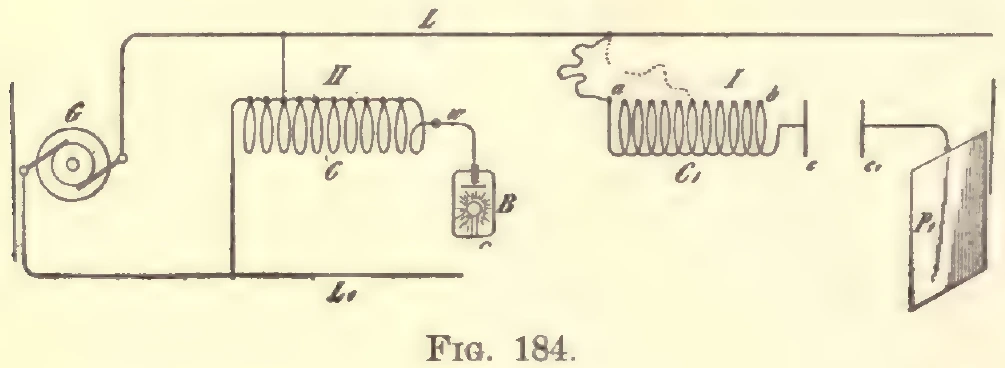
Resonance is the method, and that is why this is an engineering plan rather than a vision. He is not going to measure a wattage. He is going to sweep frequency and watch a potential until the earth answers at its own rate. The plate above, printed two pages before the earth passage, is the book's own picture of that kind of study: a coil of many turns, divided into sections so the adjustment can be made in steps, driven by a high-frequency alternator (1894, p. 344).
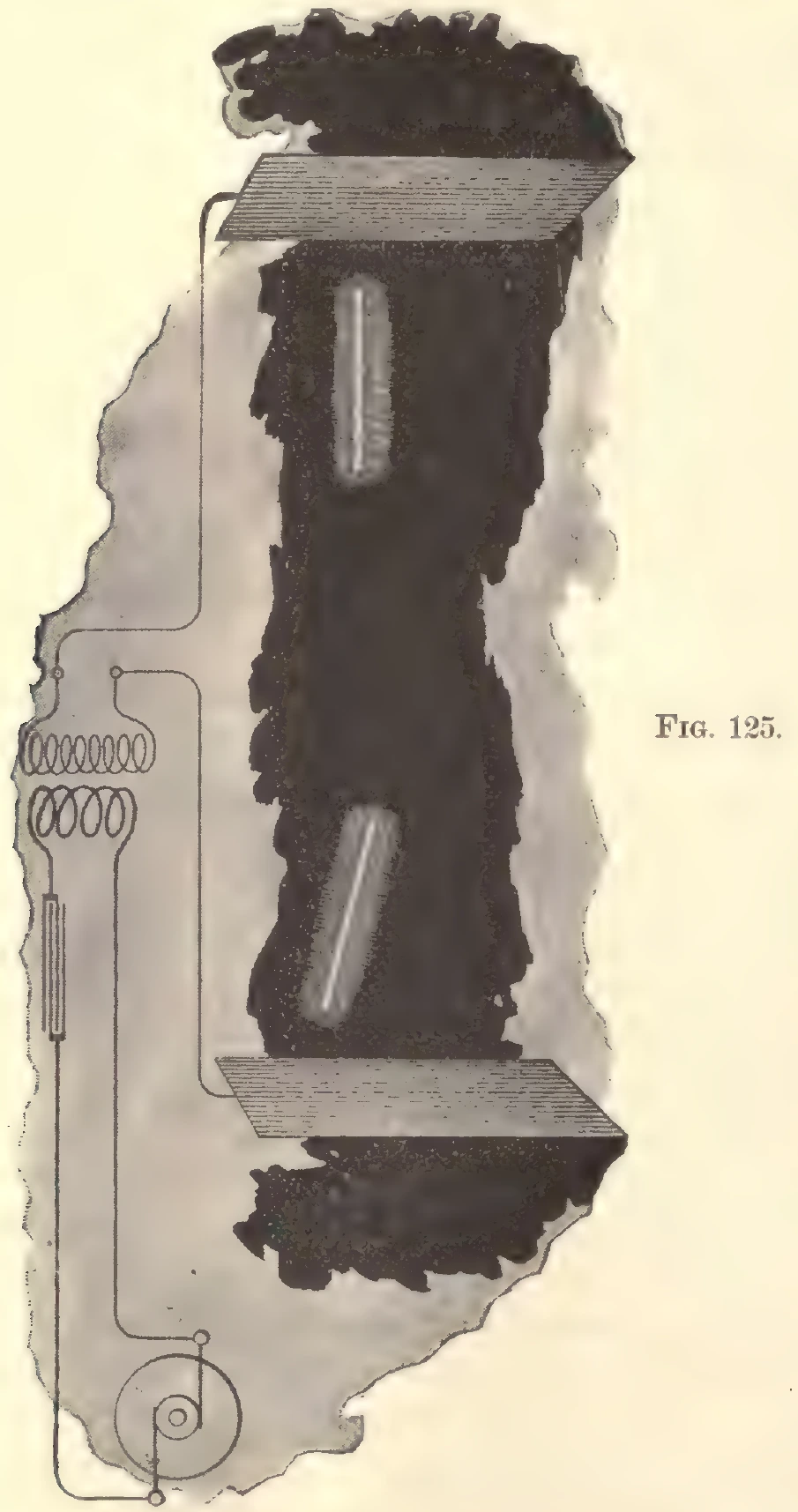
The second plate below marks the size of the gap instead. It comes from the 1891 lecture, and it shows what he had actually built: two metal sheets suspended in a room, each connected with one of the terminals of the induction coil and their size carefully determined, so that an exhausted tube carried in the hand anywhere between them stays luminous (1894, p. 189). That is a room filled with a rapidly alternating electrostatic field, made by a coil on a bench, and it is the honest edge of the demonstrated record. The hand-held tube belongs to Tesla's lamps lit without wires, which works through the 1891 demonstration in full. The earth plan of pp. 346 to 349 is the same thought applied to a planet, with the frequency, the potential and the period all still unknown.
What He Claimed, and What He Refused to Claim
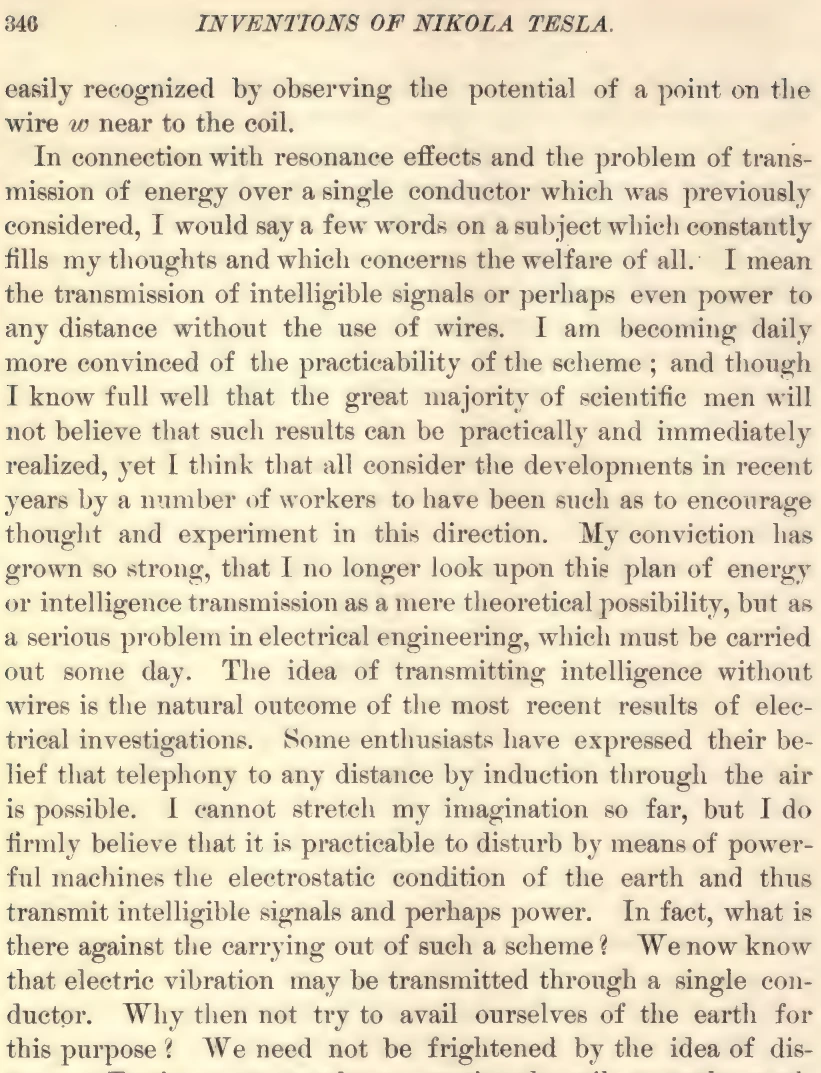
The claim, in his own words: "I mean the transmission of intelligible signals or perhaps even power to any distance without the use of wires" (1894, p. 346). The two words that do the work are "perhaps even".
He states his conviction and its limits in the same sentence group. "I am becoming daily more convinced of the practicability of the scheme" (1894, p. 346), and then: "though I know full well that the great majority of scientific men will not believe that such results can be practically and immediately realized" (1894, p. 346). The form he chooses is not a prophecy. "I no longer look upon this plan of energy or intelligence transmission as a mere theoretical possibility, but as a serious problem in electrical engineering, which must be carried out some day" (1894, p. 346).
He also refuses a claim that people around him were making. "Some enthusiasts have expressed their belief that telephony to any distance by induction through the air is possible" (1894, p. 346). His answer: "I cannot stretch my imagination so far, but I do firmly believe that it is practicable to disturb by means of powerful machines the electrostatic condition of the earth and thus transmit intelligible signals and perhaps power" (1894, p. 346).
The version he thought likelier is much smaller than the myth. "I think that beyond doubt it is possible to operate electrical devices in a city through the ground or pipe system by resonance from an electrical oscillator located at a central point" (1894, p. 349). He ranks the two ideas himself, and puts the one that sounds grander second: the city scheme would be "of incomparably smaller benefit to man than the realization of the scheme of transmitting intelligence, or perhaps power, to any distance through the earth or environing medium" (1894, p. 349).
The Arithmetic, and the Number He Did Not Have
The step from the laboratory to the planet is put as a question. "We now know that electric vibration may be transmitted through a single conductor. Why then not try to avail ourselves of the earth for this purpose?" (1894, p. 346).
What he could calculate, he calculated, and the numbers come from the 1891 lecture. At moderate potential, getting current to a distance is not the difficulty: "there is no particular difficulty encountered in conveying currents from a machine giving ... say, 20,000 alternations per second, to quite a distance. This number of alternations, however, is by far too small for many purposes, though quite sufficient for some practical applications" (1894, p. 151). On the transmitting side the theory is generous: "Theoretically, then, it could not require a great amount of energy to produce a disturbance perceptible at great distance, or even all over the surface of the globe" (1894, p. 348). Then he marks the edge of what he had worked out: "at what distance such a vibration might be made perceptible can only be conjectured" (1894, p. 348).
The missing number is named plainly. "A point of great importance would be first to know what is the capacity of the earth?" (1894, p. 346). He did not know it, and he says the only way to it is the resonance hunt: "If ever we can ascertain at what period the earth's charge, when disturbed, oscillates with respect to an oppositely electrified system or known circuit, we shall know a fact possibly of the greatest importance to the welfare of the human race" (1894, p. 347).
The rhetoric belongs to a different year, and it should be quoted with that attached. In the 1891 lecture he writes that there is "a possibility of obtaining energy not only in the form of light, but motive power, and energy of any other form, in some more direct way from the medium" (1894, p. 196), and that "the time has come when one may utter such words before an enlightened audience without being considered a visionary" (1894, p. 196). He is defending the right to say it, not reporting it done. The famous sentence runs across a page break, so quote it from where the print allows: we "are whirling through endless space with an inconceivable speed, all around us everything is spinning, everything is moving, everywhere is energy" (1894, p. 197). It ends in a request, not an announcement: "There must be some way of availing ourselves of this energy more directly" (1894, p. 197). The same lecture closes the question for him: "How far the results here borne out are capable of practical applications will be decided in the future" (1894, p. 196).
What the Internet Gets Wrong
That Tesla demonstrated wireless power in 1893. The 1893 record is a proposal with conditions, and the book's own recap of the lectures uses the words that say so. Of this same subject the editor writes: "He expressed his firm conviction that by observing proper conditions, intelligence, and possibly even power, can be transmitted through the medium or through the earth; and he considers this problem worthy of serious and immediate consideration" (1894, p. 143). That is the editor describing a lecture in the third person, so it cannot be put in Tesla's mouth. It is still the book's own reading of its own material, and the phrase carrying it is "by observing proper conditions" (1894, p. 143). The conditions are printed on pp. 347 and 348, and the next section is what he says about them.
That this book is the Wardenclyffe story. It is not, and it never mentions it. A search of the text layer of our scan returns 0 occurrences of "Wardenclyffe", 0 of "Colorado Springs" and 0 of "world system". The word "wireless" does not occur in this volume in any spelling; the phrase he uses is transmission "without the use of wires" (1894, p. 346). The tower belongs to a later decade and a different project: built at Shoreham on Long Island from 1901, funded by J. P. Morgan, abandoned by 1906 without ever going into service. That comes from a modern secondary source, named as such in the Sources list, not from this book. The two stories are habitually merged, and the merge flatters the 1893 plan with experiments that had not been performed yet.
The pattern in every version of this mistake is the same: a proposal gets compressed into an achievement. The 1893 text is more interesting than the compressed version, not less. It names the measurement that was missing and the machine that would have to be invented to make it, and the next section is in his own words about exactly those.
The same compression happens to a different phrase, and this site checked that one word by word in this same text layer and printed the counts that came back: What Tesla Actually Wrote About Free Energy.
Why It Did Not Happen
He names three obstacles himself, and he puts them in order.
The first is the machine, and he states it as the likely answer rather than as a difficulty. If the earth's period turns out to be extremely short, he writes, "then a dynamo machine would not do and a proper electrical oscillator would have to be produced and perhaps it might not be possible to obtain such rapid vibrations" (1894, p. 347). The whole plan is a hunt for a resonance, so a source that cannot produce the frequency is not a limitation on the experiment. It ends the experiment.
The second is the fall-off. "But the disturbance will diminish with the distance, and the distance at which the effect will still be perceptible will depend on the quantity of electricity set in motion" (1894, p. 348). The quantity is bought with potential: "Since the body p is insulated, in order to displace a considerable quantity, the potential of the source must be excessive" (1894, p. 348). He has already said what an excessive potential costs, four chapters earlier, in the lecture of 1891. "It will be found difficult to provide the requisite insulation without considerably increasing the size of the apparatus, for the potentials required are high, and, owing to the rapidity of the alternations, the insulation presents peculiar difficulties" (1894, p. 151). Then the engineering consequence, from the same paragraph of that lecture: "The chief requisite in the insulation of the apparatus is, therefore, the exclusion of any gaseous matter" (1894, p. 151). A machine that has to be kept free of gas is a dearer machine than the open coil on the bench.
The third he states last and most plainly: "Proper apparatus must first be produced by means of which the problem can be attacked and I have devoted much thought to this subject" (1894, p. 349). Not the idea. The apparatus.
There is a fourth reason the book does not give, because it is about the world the plan did not happen in. In those same years the distribution systems being built were settling on 50 and 60 cycles, with copper conductors, transformers and meters, and every part of that chain gets cheaper as it gets bigger. A single-conductor system working at tens or hundreds of thousands of alternations per second does not share those costs, and the higher the frequency the worse the wire behaves. The book works out that loss itself, in the one-wire chapter, and the arithmetic belongs to Tesla's one-wire power. The machines that could reach those frequencies at all, with their pole counts and their speeds, are the subject of Tesla's high-frequency alternator. Those are engineering problems with answers. The electrical period of the earth, which the plan needed before anything could be sized, was not a problem of that kind, and in 1893 nobody had the number.
What This Looks Like From a House
The sentence to quote last, and only after the conditions above: "I am firmly convinced that it can be done and hope that we shall live to see it done." (1894, p. 349) In the book it lands at the end of a section that has just said the apparatus does not exist and the period is unknown. In that position it is a working belief. Cut out of that position it becomes the prophecy this page exists to correct.
The energy that runs a house still arrives the boring way: two conductors, a transformer, a meter, and a frequency the utility holds at 60 cycles. Everything above sits on the far side of that line, at potentials in the hundreds of thousands of volts and frequencies the book counts in alternations per second, with a return path made of the capacitance of a plate.
Sizing a real supply for a real house is a set of ordinary questions: how many watts, stored where, and what the conductors have to carry. Those can be answered now, and that is the actual difference between an 1893 proposal and a home installation. Powering your whole home with a magnetic generator works through that sizing; if the choice is against a roof of panels, magnetic generator versus solar power is the comparison run on real equipment.
Frequently Asked Questions
Did Nikola Tesla Invent Wireless Power?
He proposed it, in his own words, and he hedged it. In a lecture delivered to the Franklin Institute in February 1893 and to the National Electric Light Association at St. Louis, he wrote: 'I mean the transmission of intelligible signals or perhaps even power to any distance without the use of wires' (1894, p. 346). The demonstration the famous paragraph rests on was a small motor turned by one insulated line in a laboratory (1894, p. 138). No power system was shown, and the measurement the plan needed, the electrical period of the earth, had not been made (1894, p. 347).
What Did Tesla's Wireless Power Plan Actually Look Like?
Two connections and the planet. 'One of the terminals of the source would be connected to earth as, for instance, to the city water mains ... the other to an insulated body of large surface' (1894, p. 347). He would raise the potential as high as insulation allowed, then hunt for resonance: 'By varying the frequency of the currents and carefully observing the potential of the insulated body and watching for the disturbance at various neighboring points of the earth's surface resonance might be detected' (1894, p. 347). The receiver was not a coil in a box; it was another ground connection and another elevated body.
Did Tesla Call It His World System?
Not in this book. A word search of the full text of the 1894 edition returns 0 occurrences of 'world system', 0 of 'Wardenclyffe' and 0 of 'Colorado Springs'. That vocabulary belongs to Tesla's later writing and to the Wardenclyffe project of 1901 to 1906 at Shoreham on Long Island, which is a separate and much better documented story. The 1893 text in this volume calls the idea 'a serious problem in electrical engineering, which must be carried out some day' (1894, p. 346).
Why Did Tesla's Wireless Power Never Work?
He says so himself, and the reasons are ordinary. The earth's capacity and its period of oscillation were unknown, and if the period is very short then 'a dynamo machine would not do and a proper electrical oscillator would have to be produced and perhaps it might not be possible to obtain such rapid vibrations' (1894, p. 347). The disturbance falls off with distance, and to move enough electricity through an insulated body 'the potential of the source must be excessive' (1894, p. 348). At those potentials insulation becomes the machine: 'The chief requisite in the insulation of the apparatus is, therefore, the exclusion of any gaseous matter' (1894, p. 151).
Wireless power in 1893 was an open problem in electrical engineering, not a finished system. If you are wiring a home generator today, the plans we recommend come with a parts list and a straight answer about output.
We earn a commission if you buy through that link. It does not change what the 1894 book says.
Sources
- The Inventions, Researches and Writings of Nikola Tesla, ed. Thomas Commerford Martin. New York: D. Van Nostrand, 1894 (entered 1893). Scan: archive.org item inventionsresear00martiala. Public domain.
- Chapter XXVIII, 'ON LIGHT AND OTHER HIGH FREQUENCY PHENOMENA', a lecture delivered before the Franklin Institute, Philadelphia, in February 1893, and before the National Electric Light Association at St. Louis (the book's footnote giving these dates is cut at a page break on printed p. 294, so the second date is not printed in full). The earth-transmission passage is printed pp. 346 to 349 of the 1894 edition; the resonance plan in Fig. 184 is printed p. 344
- Chapter XXV, the editor's introduction 'THE SCOPE OF THE TESLA LECTURES', printed pp. 119 to 144. The paragraph quoted at the head of this article is printed p. 138 and the summary sentence quoted in the section on what the internet gets wrong is printed p. 143. Both are Thomas Commerford Martin's recap of the lectures in the third person, not Tesla's text
- Chapter XXVI, 'EXPERIMENTS WITH ALTERNATE CURRENTS OF VERY HIGH FREQUENCY AND THEIR APPLICATION TO METHODS OF ARTIFICIAL ILLUMINATION', a lecture delivered before the American Institute of Electrical Engineers at Columbia College, N. Y., May 20, 1891. The passage on what a few thousand volts and 20,000 alternations per second will do, and on the insulation wall, is printed p. 151; the closing passage is printed pp. 196 and 197; the electrostatic-field room and Fig. 125 are printed pp. 188 and 189
- Word search of the full text of this edition for 'world system', 'Wardenclyffe' and 'Colorado Springs': 0 occurrences each. The text layer is books/extracted/tesla-1894-plain.txt and the search is re-runnable with books/tools/grep_quote.py
- Wikipedia, "Wardenclyffe Tower", for the dates and site of the later project (secondary source, checked 2026-10-11)
- Every quote here was re-grepped from the text layer of our scan and pinned to its printed page before drafting; the register is new_content/1894-series/04-tesla-wireless-power-1893/quotes.md, re-runnable with books/tools/grep_quote.py and regenerated by gen_quotes.py in that directory
- Pages of the 1894 edition used here: p. 138, p. 143, p. 151, p. 188, p. 189, p. 196, p. 197, p. 344, p. 345, p. 346, p. 347, p. 348, p. 349