Tesla's High-Frequency "Massage" Cure of 1891
The 1894 File · No. 5 of 12. Every quote below is cited from the first edition, page numbers included.
Published: October 22, 2026 | Updated: October 22, 2026
Standfirst. Nikola Tesla printed two pages about passing high-frequency currents through the human body, and the 1894 book reproduces them in full. In the first he insists he is not putting himself on record as a patent-medicine man. In the second he warrants exactly one effect, heating, and closes by writing that whether the effects are beneficial remains to be proved. The industry that later put his name on devices kept neither of those sentences.
The Paper, and Its Defensive Opening
Printed pp. 394 to 395 of the 1894 volume carry chapter XXXI. The heading sets the word MASSAGE inside the printer's own quotation marks, which is the book's punctuation and not ours, and that heading is display type, so it is not quoted here. The footnote on p. 394 dates the paper: an article by Tesla in The Electrical Engineer, Dec 23 1891. Our scan garbles that footnote, so the provenance is stated in our words rather than printed inside quotation marks.
The chapter is two pages long, and it opens on the defensive:
"I trust that the present brief communication will not be interpreted as an effort on my part to put myself on record as a "patent medicine" man, for a serious worker cannot despise anything more than the misuse and abuse of electricity which we have frequent occasion to witness" (1894, p. 394)
He is not pitching. He is answering mail. "My remarks are elicited by the lively interest which prominent medical practitioners evince at every real advance in electrical investigation" (1894, p. 394), and then the plain version of the same sentence: "I have received many letters from noted physicians inquiring as to the physical effects of such currents of high frequency" (1894, p. 394).
The most the paper concedes to medicine comes three sentences earlier: "progressive physicians also should expect to find in it a powerful tool and help in new curative processes" (1894, p. 394). Read the grammar. It is an expectation about what physicians should look for, not a report of anything found.
One thing to fix before going further. This is not the 1894 book speaking; it is a trade-paper article from December 1891, reprinted. Two other texts are quoted on this page and they are different papers too. Chapter XXX, printed p. 393, is an article in the same magazine from May 6 1891. The physiological caution quoted below comes from the lecture Tesla delivered at Columbia College on May 20 1891, printed p. 162. The volume's own index files pp. 162 and 394 under one subject heading, Physiological Effects (1894, p. 495), which is why they belong on one page here. Nobody should write "Tesla wrote in 1894". The book is 1894; the writing is 1891.
The Mechanism He Described
The effect he claims is one sentence long, and it is a claim about a body in a field, not about a current driven through a tissue: "a body perfectly well insulated in air can be heated by simply connecting it with a source of rapidly alternating high potential" (1894, p. 394).
The explanation attached to it is a hypothesis, and he marks it as one. "The heating in this case is due in all probability to the bombardment of the body by air, or possibly by some other medium, which is molecular or atomic in construction, and the presence of which has so far escaped our analysis" (1894, p. 394). Note "in all probability" and "possibly". He is proposing a mechanism about a medium he says has escaped analysis.
Then the sentence that decides what kind of effect this is: "This body may be a good conductor or it may be a very poor conductor of electricity with little change in the result" (1894, p. 394). If the heating hardly changes when the body stops conducting, the heating is not current passing through the body. He adds, in the sentence the therapy trade later built a market on: "The human body is, in such a case, a fine conductor" (1894, p. 394).
The sentence that finishes the thought runs across a page break, with the chapter footnote printed between the two halves, so it has to be quoted in pieces, each to its own page. "if a person insulated in a room, or no matter where, is brought into contact with such a source of" (1894, p. 394) ... "the skin is heated by bombardment" (1894, p. 395).
What he will say about the machine is equally short: "It is a mere question of the dimensions and character of the apparatus to produce any degree of heating desired" (1894, p. 395). That is an engineering sentence. Heat is a design problem, and the design problem is the source.
The source is the same family of apparatus that lit the tubes he held, and Tesla's lamps lit without wires works through that demonstration in full. It is also where the honest limit sits. A hand-held tube and a warm body are the same effect at different scales, and the currents at useful output came from machines with hundreds of iron poles: an experimental machine reached about 15,000 alternations per second, and a rotor with 480 polar projections on each side gave 30,000 (1894, pp. 376, 381). Those machines, and the reasons they were hard to build, are the subject of Tesla's high-frequency alternator.
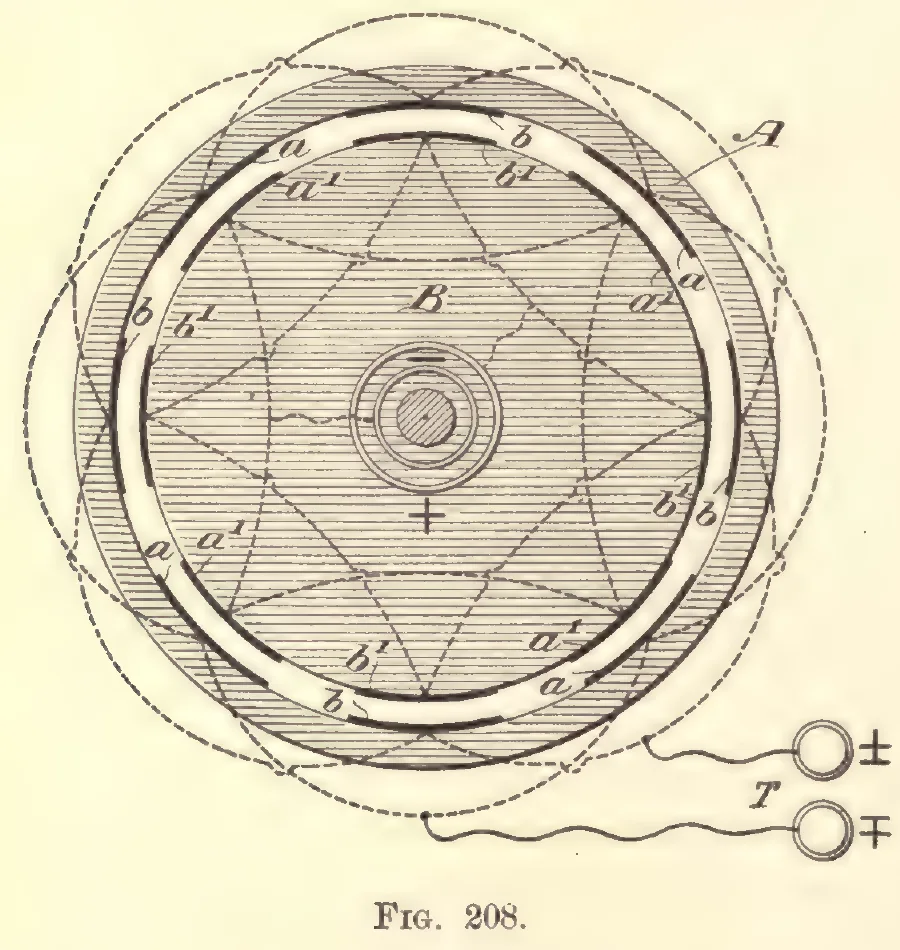
The plate above belongs to the chapter next door, and it is worth pausing on it because it is the counter-example to everything the wellness version claims. That apparatus makes alternating currents of short period by rotating charged surfaces past a conductor, and Tesla describes it in the chapter it belongs to, not in the massage paper. It is here because chapter XXXI has no illustration of its own, and because the same man, two chapters earlier, was careful to say what such a machine could not do.
The North Pole Thought Experiment
Here is the therapy sentence, written as he actually writes it: "It has occurred to me whether, with such apparatus properly prepared, it would not be possible for a skilled physician to find in it a means for the effective treatment of various types of disease" (1894, p. 395).
It is a conditional question with two conditions bolted on: apparatus 'properly prepared', and 'a skilled physician'. The word 'disease' occurs once in the whole volume, in that sentence. The paper names no condition it treats, no patient, and no result.
Then the sentence that tells a reader what the device reaches: "The heating will, of course, be superficial, that is, on the skin, and would result, whether the person operated on were in bed or walking around a room, whether dressed in thick clothes or whether reduced to nakedness" (1894, p. 395). Surface heating, through clothing, in a room, standing up. That is the whole of the demonstrated claim, and it is what makes the next line a joke rather than a proposal: "it is conceivable that a person entirely nude at the North Pole might keep himself comfortably warm in this manner" (1894, p. 395).
'It is conceivable' is doing the work. He has taken the apparatus to the point where an obviously absurd consequence follows, and he leaves it there. A writer trying to sell a cure does not end a paragraph on a man at the North Pole.
What He Explicitly Did Not Claim
The hedge is not buried; it is the last movement of the paper. "Without vouching for all the results, which must, of course, be determined by experience and observation" (1894, p. 395), and then the thing he is willing to stand behind: "I can at least warrant the fact that heating would occur by the use of this method of subjecting the human body to bombardment by alternating currents of high potential and frequency such as I have long worked with" (1894, p. 395).
Heat. Not a cure, not a treatment, not a diagnosis. Heat.
He then says the opposite of endorsing the electrotherapy of his own decade: "It is only reasonable to expect that some of the novel effects will be wholly different from those obtainable with the old familiar therapeutic methods generally used" (1894, p. 395). Whatever these currents do, he expects it not to be what the electric-bath people were already doing.
The final sentence of the chapter is the one to quote last: "Whether they would all be beneficial or not remains to be proved." (1894, p. 395)
A word search of the text layer of our scan makes the silence concrete. Across the whole volume: "cure" 0 occurrences, "curing" 0, "cured" 1 (printed p. 69, about something else), "disease" 1 (the hypothetical sentence above). The paper reports no therapeutic outcome.
He did publish a caution about these currents, and it is worth having in his words rather than ours. It is from the Columbia College lecture of May 20 1891, which the book's index files with the massage paper under one heading: "while it is an undeniable fact that they are incomparably less dangerous than currents of low frequencies, it should not be thought that they are altogether harmless" (1894, p. 162). The reason is the size of the source, and he names it: "if received directly from a machine or from a secondary of low resistance, they produce more or less powerful effects, and may cause serious injury, especially when used in conjunction with condensers" (1894, p. 162). That is a warning about a machine and a jar, not about a handheld wand, and nothing on this page is an invitation to try any of it at home.
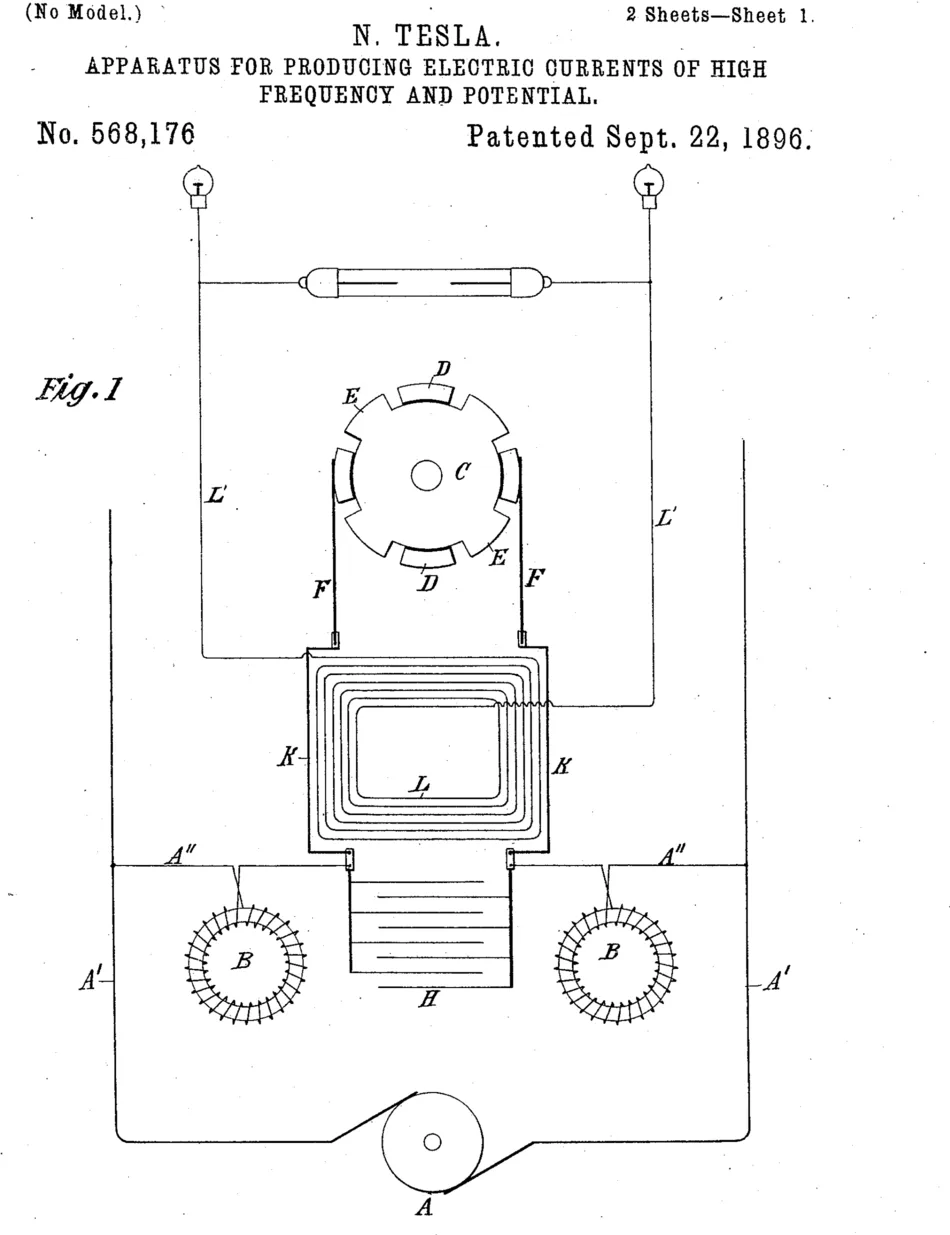
The warning is about a circuit, and this is a circuit: a rotary interrupter C carrying toothed segments under two brushes F, the segments D insulated and the segments E joined to the body of the cylinder so that the circuit closes as the wheel turns, a plate condenser H, a transformer with a primary K and a secondary L, and choking coils B in the supply line. Tesla patented it in 1896, four years after the paper the book prints as chapter XXXI, and it is not the machine of the 1891 demonstrations, which no text in this volume describes part by part. It belongs on this page because it is what his own sentences keep pointing at. The massage paper puts the whole effect in a design question, 'It is a mere question of the dimensions and character of the apparatus to produce any degree of heating desired' (1894, p. 395), and the lecture says where the hazard sits: in the machine, the secondary and the condenser. Neither passage is about a hand-held wand, and neither one sets out a dose.
What the Internet Gets Wrong
That Tesla signed off on current therapy. He signed off on heating, and he published the limit in the same paragraph as the claim. The two sentences that a device page has to reproduce to claim him are the two it usually drops: "Without vouching for all the results, which must, of course, be determined by experience and observation" (1894, p. 395), and "Whether they would all be beneficial or not remains to be proved." (1894, p. 395) A seller who keeps those two sentences is entitled to cite the paper. A seller who cuts them is selling something else.
That the market vocabulary is his. It is not in this book. A word search of the text layer of our scan returns 0 occurrences of 'violet ray', 0 of 'electric bath', 0 of 'electrotherapy' and 0 of 'diathermy'. The word 'violet' occurs twice, on printed pp. 163 and 218, and both times about the colour of a discharge, never as the name of a treatment. The word 'massage' occurs four times in this volume and not one of them is prose: the chapter heading (printed p. 394), the table of contents, and two index entries (printed pp. 494 and 495). It is not used once in the running text.
That the descendant is the same treatment. The legitimate heir of this work in medicine is short-wave diathermy, and it is a different thing by construction. A 2024 review in Cureus describes diathermy as the use of radio-frequency energy to generate heat inside body tissue, and reports that the US FDA recognises it as a therapeutic method producing heating beneath the skin, in muscles and joints. Deep heating is the entire point, and it takes an applicator, a frequency and a dose. Tesla's own sentence says his heating would be superficial, on the skin (1894, p. 395). The same literature is candid about the evidence: a 2023 survey of physiotherapists notes that use of short-wave diathermy has fallen in some countries for want of evidence of efficacy. So the honest sentence is narrow: high-frequency currents became a clinical tool, on a different mechanism, with a contested evidence base, and none of that transfers to a device that invokes a 1891 paper.
That the excitement was his. He was watching it, and he wrote it down: "The progress in recent years has been so great that every electrician and electrical engineer is confident that electricity will become the means of accomplishing many things that have been heretofore, with our existing knowledge, deemed impossible" (1894, p. 394). That is his sentence about his audience's confidence, and the paper exists to answer it. He is not endorsing that confidence. He is the man who wrote, two sentences later, that whether the new effects would be beneficial remains to be proved (1894, p. 395).
The Test He Set Himself
Two chapters earlier, in the chapter the figures on this page come from, Tesla wrote the check that any high-frequency claim can be put through. About the electrostatic induction apparatus: "The output of such an apparatus is very small" (1894, p. 393). And about what it was inferior to: "The effects, however, cannot be compared with those obtainable with an induction coil which is operated by an alternate current machine of high frequency, some of which were described by me a short while ago" (1894, p. 393).
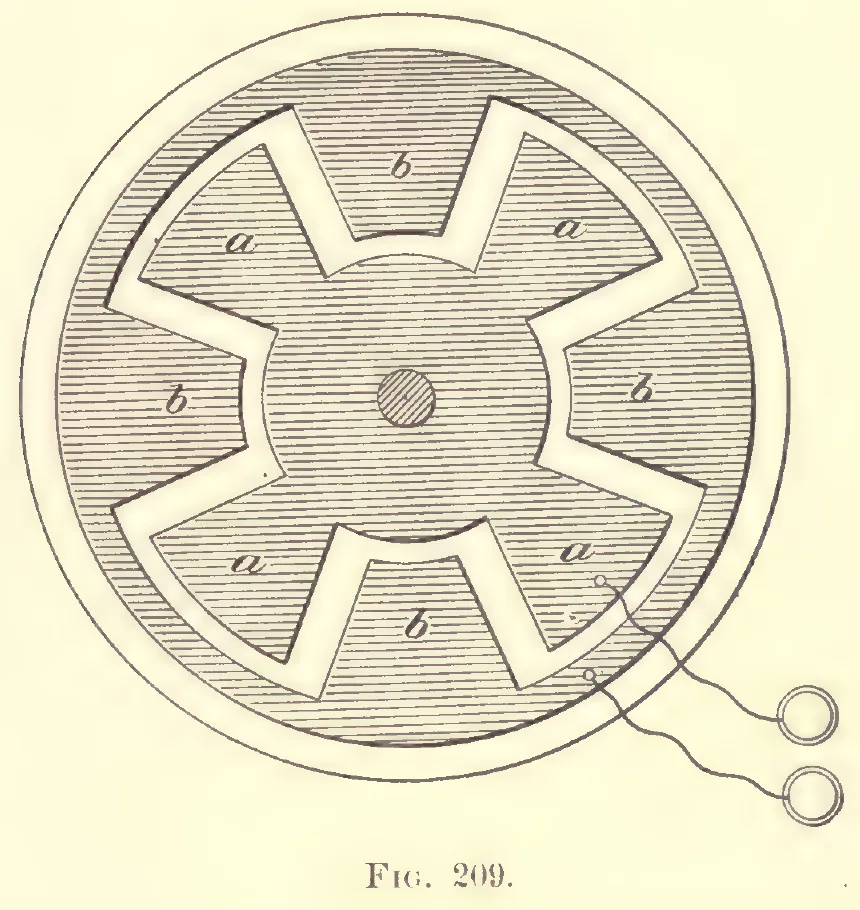
Two questions, and they are the whole method. What is the source, and what does it output? Tesla answered them about his own apparatus before anyone else could: a rotating-plate machine of that design gives a very small output, and the effects it shows are weaker than those of a coil driven by a proper high-frequency machine. He was not selling the plate machine. He was telling readers which effects it could and could not demonstrate, in a paper published seven months before the one about his own body.
That is the same two questions this site asks about its own subject, and Is the magnetic generator a scam? is where we work through them on the generator: what the device is claimed to deliver, what has been measured, and what the seller is willing to warrant. The second question usually ends in a number, and How much noise does a free-energy device make? is the same two questions pointed at an ordinary claim: a loudness figure in decibels, and the comparison it is supposed to win. The third place this site points the same two questions is at a text rather than a machine: What Tesla Actually Wrote About Free Energy is about a sentence quoted from an 1894 book, and about the two-word phrase that book never uses.
The 1891 paper is useful exactly because it is so small. Two pages, one effect, one hedge, and a closing line that says the rest is unproven. Everything sold on top of that is a later invention, and the way to see it is to ask for the sentence in which the man himself vouches for it.
Frequently Asked Questions
Did Nikola Tesla Invent High-Frequency Current Therapy?
He described an effect and refused to sell it. In the article printed in the 1894 volume as chapter XXXI, dated by the book's own footnote to The Electrical Engineer of Dec 23 1891, he wrote that a body insulated in air is heated by contact with a source of rapidly alternating high potential, and that 'the human body is, in such a case, a fine conductor' (1894, p. 394). What he was willing to guarantee stops there: 'Without vouching for all the results, which must, of course, be determined by experience and observation, I can at least warrant the fact that heating would occur' (1894, p. 395). The paper names no condition it treats and reports no patient and no result.
What Did Tesla's High-Frequency 'massage' Do to the Body?
Surface heating, by his own account. 'The heating will, of course, be superficial, that is, on the skin, and would result, whether the person operated on were in bed or walking around a room, whether dressed in thick clothes or whether reduced to nakedness' (1894, p. 395). He offered a mechanism for it, the bombardment of the body by air, and hedged it himself with 'in all probability' and 'possibly' (1894, p. 394). He also noted that the body's conductivity made little difference: 'This body may be a good conductor or it may be a very poor conductor of electricity with little change in the result' (1894, p. 394), which is why this is not current passed through tissue.
Is Tesla Frequency Healing the Same As Tesla's 1891 Experiments?
The vocabulary is not in the book. A word search of the text layer of our scan returns 0 occurrences of 'violet ray', 'electric bath', 'electrotherapy' and 'diathermy'; the word 'violet' occurs twice, printed pp. 163 and 218, and both times about the colour of a discharge. The real descendant of this work in medicine is short-wave diathermy, and it is a different thing by construction: it is defined by driving radio-frequency energy deep into tissue, beneath the skin, in muscles and joints, with an applicator, a frequency and a dose (Amani et al., Cureus, 2024). Tesla's own sentence says his heating would be superficial, on the skin (1894, p. 395).
Are High-Frequency Currents Safe?
Tesla published a caution about them, and it is about the size of the source. 'While it is an undeniable fact that they are incomparably less dangerous than currents of low frequencies, it should not be thought that they are altogether harmless', he wrote in his Columbia College lecture of May 20 1891, and then named the case that matters: 'if received directly from a machine or from a secondary of low resistance, they produce more or less powerful effects, and may cause serious injury, especially when used in conjunction with condensers' (1894, p. 162). That is a warning about apparatus, not about a handheld device, and nothing here suggests trying any of it at home.
Tesla warranted one effect in 1891: heating. Everything past that, he wrote, had to be settled by experience and observation. If you are sizing a real supply for a home today, the plans we recommend come with a parts list and straight answers about output.
We earn a commission if you buy through that link. It does not change what the 1894 book says.
Sources
- The Inventions, Researches and Writings of Nikola Tesla, ed. Thomas Commerford Martin. New York: D. Van Nostrand, 1894 (entered 1893). Scan: archive.org item inventionsresear00martiala. Public domain.
- Chapter XXXI, '" MASSAGE " WITH CURRENTS OF HIGH FREQUENCY', printed pp. 394 to 395 of the 1894 edition. The chapter's own footnote (printed p. 394, footnote 1) dates it to an article by Mr. Tesla in The Electrical Engineer, Dec. 23, 1891; this scan garbles that footnote, so the date is given in our words and not quoted
- Chapter XXX, 'ALTERNATE CURRENT ELECTROSTATIC INDUCTION APPARATUS', printed pp. 392 to 393. Its footnote verifies as printed: 'Article by Mr. Tesla in The Electrical Engineer, N. Y., May 6, 1891.' (printed p. 392). The two figures on this page come from this chapter, which §6.6 allows for this article because chapter XXXI has no illustration
- Chapter XXVI, 'EXPERIMENTS WITH ALTERNATE CURRENTS OF VERY HIGH FREQUENCY AND THEIR APPLICATION TO METHODS OF ARTIFICIAL ILLUMINATION', a lecture delivered before the American Institute of Electrical Engineers at Columbia College, N. Y., May 20, 1891. The physiological caution is printed p. 162. The volume's own index (printed p. 495) files pp. 162 and 394 together under the subject heading Physiological Effects, which is why both are quoted here
- Word search of the text layer of our scan (books/extracted/tesla-1894-plain.txt), whole volume, whole-word matching: 'cure' 0, 'curing' 0, 'cured' 1 (printed p. 69, a different subject), 'disease' 1 (printed p. 395, in the hypothetical sentence quoted here), 'violet ray' 0, 'electric bath' 0, 'electrotherapy' 0, 'diathermy' 0, 'physiotherapy' 0, 'massage' 4. The four 'massage' occurrences are the chapter heading (printed p. 394), the table of contents (front matter) and two index entries (printed pp. 494 and 495); the word is not used once in the running text
- Amani T, Surenthar M, Prethipa R. "Frontier Breakthroughs: A Comprehensive Review of Diathermy in Dentistry With a Focus on Oral Medicine." Cureus 16:4 (2024) e57427, for the description of short-wave diathermy as deep heating by radio-frequency energy, and for the report that the US FDA recognises diathermy as a therapeutic method producing heating beneath the skin, in muscles and joints
- Almalty AR, Abdelnour HM, Hawamdeh M, Alkhob SA. "Physiotherapists' Understanding of Shortwave Diathermy Contraindications: A Questionnaire Survey." Risk Management and Healthcare Policy 16 (2023) 1171 to 1185, for the statement that some physiotherapy services have reduced their use of short-wave diathermy for want of evidence of efficacy
- US patent 568,176, 'Apparatus for Producing Electric Currents of High Frequency and Potential', Nikola Tesla, of New York, application filed April 22 1896, patented September 22 1896. The number, title and date were read off the drawing sheet used as the figure on this page, and the same three are given in the public record at patents.google.com, checked 11 October 2026
- Every quote here was re-grepped from the text layer of our scan and pinned to its printed page before drafting; the register is new_content/1894-series/05-tesla-high-frequency-massage/quotes.md, re-runnable with books/tools/grep_quote.py and regenerated by gen_quotes.py in that directory
- Pages of the 1894 edition used here: p. 162, p. 392, p. 393, p. 394, p. 395, p. 495