Tesla's One-Wire Power: The Experiment Textbooks Skip
The 1894 File · No. 2 of 12. Every quote below is cited from the first edition, page numbers included.
Published: October 20, 2026 | Updated: October 20, 2026
Standfirst. Nikola Tesla told the Institution of Electrical Engineers in February 1892 that currents of high frequency and high potential "enable us to perform many experiments by the use of one wire only" (1894, p. 232). The 1894 book prints what he meant: a motor, an electrolytic cell and a lamp, each worked from a single connection. It also prints his reason for doing it, and the reason is an engineering one.
The Rule, and the Exception He Found
Every reader was taught the same rule. Current goes out and comes back: a source, a load, and two conductors between them. At 50 or 60 Hz, in a house or a distribution line, that is not a convention. It is what makes the circuit close.
Tesla does not argue against the rule. He argues that at high frequency and high potential the second conductor stops being a piece of copper, and that this is worth knowing because of what it lets you build.
He also keeps the parts of the argument in order. First the demonstrations, with the apparatus described and the currents described. Then a calculation about whether any of it is worth the cost. The second part is the part most retellings drop.
What He Did With a Single Conductor
"A most curious feature of alternate currents of high frequencies and potentials is that they enable us to perform many experiments by the use of one wire only." (1894, p. 232)
Then he lists the experiments, and the first is a line.
"We may connect an insulated line to a source of such currents, we may pass an inappreciable current over the line, and on any point of the same we are able to obtain a heavy current, capable of fusing a thick copper wire." (1894, p. 236)
That is a measurement claim, not a stage trick. The current travelling along the line is too small to matter. The current you can draw from any point on it will melt a thick copper wire. The line is not carrying the load; it is holding a high alternating potential, and the load completes itself through the surroundings.
The second is chemistry, and he allows for an artifice in it. A solution can be decomposed in an electrolytic cell "by connecting only one pole of the cell to the line or source of energy" (1894, p. 236). The third is light: "Or we may, by attaching to the line, or only bringing into its vicinity, light up an incandescent lamp, an exhausted tube, or a phosphorescent bulb." (1894, p. 236)
He marks exactly which part of this he calls settled. "It is now a fact that a body may be rendered incandescent or phosphorescent by bringing it either in single contact or merely in the vicinity of a source of electric impulses of the proper character" (1894, p. 236). That is a claim about lamps, worded as a claim about lamps, and it is the only one of the three he puts in that form.
The Motor With One Connection
The demonstration he chose for the lecture was a motor, and he picked its type on purpose. It is the simplest thing that will turn: a coil on an iron core, a copper disc near it, and nothing else in motion.
He is candid about not knowing why it works. Whether the effect comes from a true time lag in the magnetisation of the core, or from eddy currents circulating in minute paths, he writes, "must remain an open question" (1894, p. 233).
What he will assert is the result: "a coil wound upon an iron core and traversed by an alternating current creates a moving field of force, capable of setting an armature in rotation." (1894, p. 233)
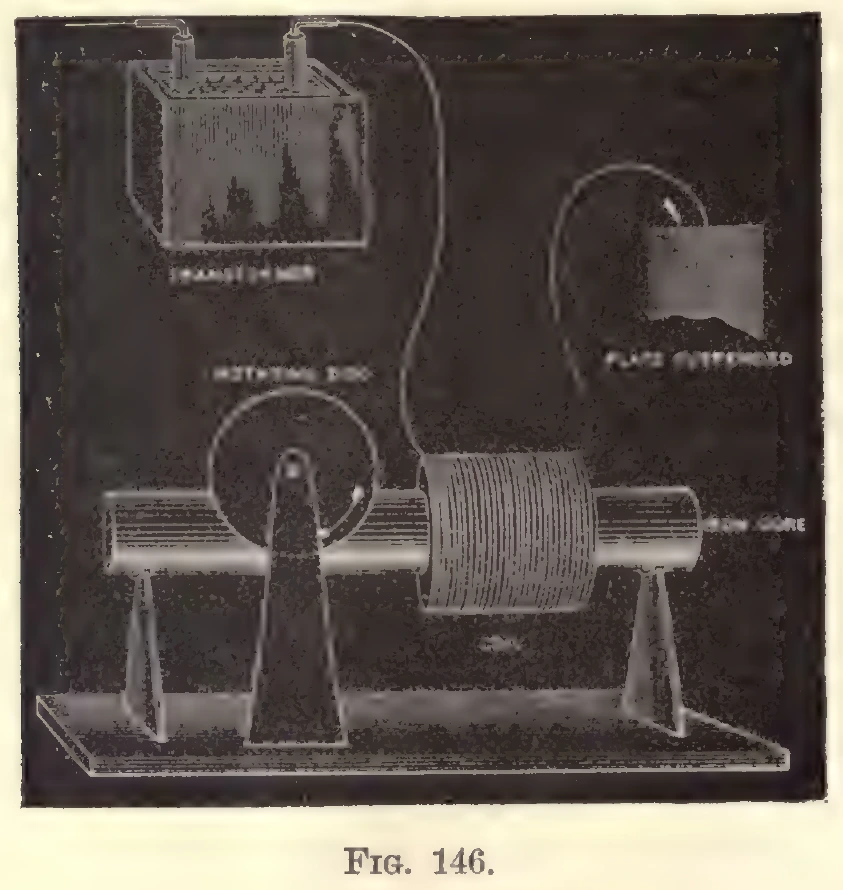
Then the reason he chose this motor, which is the point of the passage. "this motor rotates with one single connection between it and the generator", one terminal of the motor to one terminal of a high-tension coil, "the other terminals of motor and generator being insulated in space." (1894, p. 234)
One wire, and the disc turns. To make it turn reliably he adds one condition: "To produce rotation it is generally (but not absolutely) necessary to connect the free end of the motor coil to an insulated body of some size" (1894, p. 234).
And then: "The experimenter's body is more than sufficient." (1894, p. 234) That is the same fact as the lamp held in a hand, and it is why the two demonstrations sit in the same chapter.
The proof that a real current is moving, rather than a field sitting there, is in the same paragraph: "If an exhausted tube is put in series with the coil, the tube lights brilliantly, showing the passage of a strong current." (1894, p. 234)
Why It Is Not Magic
Tesla supplies the mechanism himself, and it is a condenser. Instead of the experimenter, a small sheet of metal hung on a cord does the same job: "the plate acts as a condenser in series with the coil. It counteracts the self-induction of the latter and allows a strong current to pass." (1894, p. 234)
That is a design trade, stated as one. A coil of high self-induction needs a smaller plate, which is why a single coil on an iron core was chosen: it has a great deal of self-induction. Add a closed secondary round that core and the trick gets harder, because the secondary cuts off the primary's lines and lets only a minute current through.
The two sentences that end the mystery are in the 1891 lecture, four chapters earlier. "In all cases the insulated body serves to give off the energy into the surrounding space, and is equivalent to a return wire." (1894, p. 184)
Then he removes the last wire. With the motor standing in an alternating electrostatic field, "it is not necessary to have even a single connection between the motor and generator, except, perhaps, through the ground" (1894, p. 235).
The reason is the same property in reverse: "not only is an insulated plate capable of giving off energy into space, but it is likewise capable of deriving it from an alternating electrostatic field" (1894, p. 235). The catch is in the same sentence: "though in the latter case the available energy is much smaller" (1894, p. 235).
His Own Case for One Wire
The argument for one conductor is not that copper is precious. It is that at high frequency the copper is where the energy goes.
He builds a model of the loss from the bombardment of molecules at the surface of an electrified body. His conclusion: "the total energy lost must be proportionate to the product of the frequency and the square of the electric density" (1894, p. 267).
He adds, in the same sentence, that "this law needs experimental confirmation" (1894, p. 267). Then the working rule: "To reduce the dissipation, it is necessary to work with a small electric density" (1894, p. 267), the smaller the higher the frequency.
From that he draws the conclusion the series is named for. Since "currents of very high frequencies involve considerable waste when transmitted through conductors", he writes, "it follows that, on the whole, it is better to employ one wire than two" (1894, p. 267). And the sentence the retellings skip: "economical reasons will make it advisable to use only one wire, especially if the distances are great." (1894, p. 267)
One wire because two cost more, not because the second is unnecessary. That is an engineer's case, and it is the opposite of the version in which the return path is simply waved away.
Where he thought it would actually pay is lighting. "However impracticable this plan of working may appear in many cases, it certainly seems practicable, and even recommendable, in the production of light." (1894, p. 236) A finished lamp would need very little energy, and "if wires were used at all we ought to be able to supply that energy without a return wire." (1894, p. 236)
What the Internet Gets Wrong
That Tesla proposed power without wires and was ignored. He raises the idea and closes it himself. He allows that motors of this class might be worked at a distance, since "Alternate currents, especially of high frequencies, pass with astonishing freedom through even slightly rarefied gases" (1894, p. 235), and the upper strata of the air are rarefied.
Then, in the next sentence: "But such schemes are mentioned merely as possibilities." (1894, p. 235)
The sentence that gets quoted on posters comes two lines later, and in the book it sits behind that refusal: "We shall have no need to transmit power at all." (1894, p. 235) He is talking about drawing energy from the environment, not about the one-wire circuit, and the paragraph that follows is about Crookes's radiometer, the machine he rates "the most inefficient machine ever invented" (1894, p. 236).
That a one-wire circuit is a free-energy circuit. It is a circuit with a harder supply, not a source of something for nothing. The same chapter that shows the motor turning on one wire also works out what the arrangement costs, in copper and in the air around the apparatus.
That the return path is missing. It is there. It is the capacitance of a plate, a person, the room and, often, the earth. Tesla's own words for it are "equivalent to a return wire" (1894, p. 184). An air return is a poor conductor. It is not no conductor.
What This Means for a Home Wiring Project
None of this transfers to a house at 50 or 60 Hz. Every experiment above is set down in the book as requiring high potential and high frequency, and the return it relies on is the capacitance of a plate or a body, which passes a negligible current at power frequencies.
That is why a generator, an inverter and a load are connected the ordinary way, with a neutral and a protective conductor. How a home generator system is actually wired is the practical version of that sentence.
What the 1894 chapters do change is how the rule should be worded. The rule is not "current needs two wires". It is that current needs a circuit, and the impedance of the second side of that circuit is a design variable. At power frequencies the only good answer is a second conductor; at high frequencies the room becomes a usable one.
Tesla drew the engineering version of that sentence himself, in the chapter that follows the one-wire lecture, and the book prints the plate for it. His argument is a chain of things he has already demonstrated: "Since I can pass a current through an insulated wire merely by connecting one of its ends to the source of electrical energy, since I can induce by it another current, magnetize an iron core, and, in short, perform all operations as though a return circuit were used, clearly I can also drive a motor by the aid of only one wire." (1894, p. 333) Fig. 180 is the plate of that: one line L across the top, a primary coil hanging from it, a secondary wound to carry the motor circuits, and the motor at the end of it. He gives the working range with the same care he gives everything else: "the frequencies should not be too high, not more than four or five thousand, though the rotation is produced even with ten thousand per second, or more." (1894, p. 334)
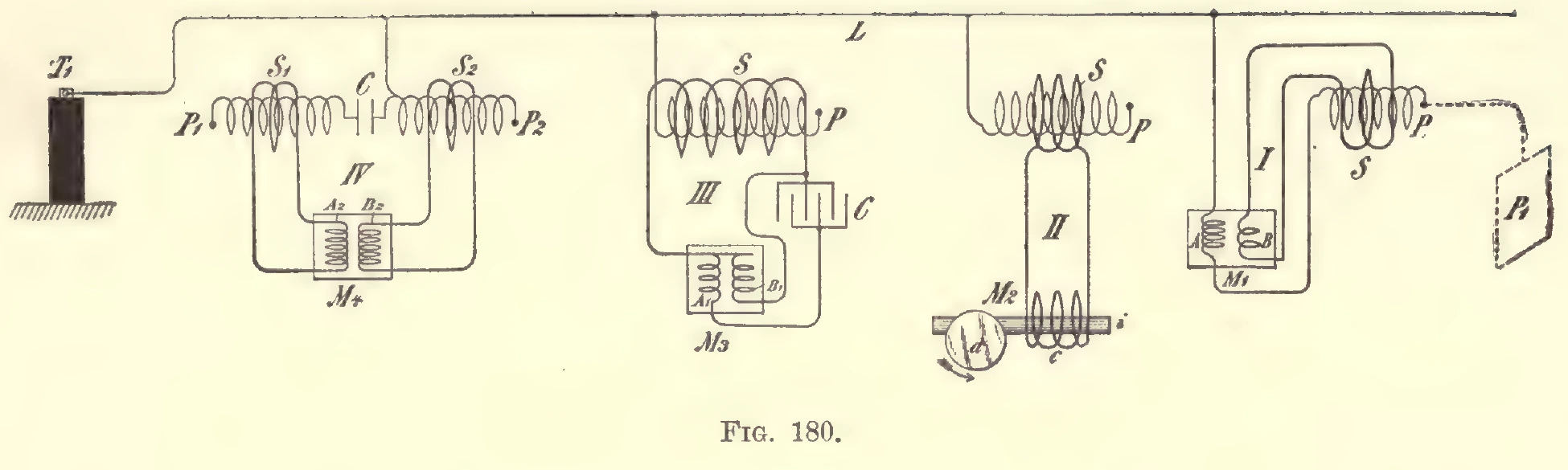
That is the honest edge of the one-wire idea. It is a high-frequency arrangement with a transformer terminal at one end and a plate, or the capacitance of the line and the room, doing the work of the second conductor. It is not a 60 Hz arrangement, and Tesla never claimed it was one.
For the machine that made these effects available, see Tesla's high-frequency alternators, with the pole counts and the speeds.
For the same single-conductor trick done with a lamp in the hand instead of a motor on a bench, see Tesla's lamps lit without wires. For the honest answer on what magnets can and cannot do in a generator you build, see can we use magnets to generate electricity.
For the version of the same idea that gives up the return path altogether, Tesla's 1893 plan for working power and signals through the earth itself, see Tesla's Wireless Power Plan, In His Own Words (1893).
Frequently Asked Questions
Does Electricity Need a Return Path?
Always: a current needs a circuit, not necessarily two wires. At 50 or 60 Hz the second side of that circuit is a conductor, which is why house wiring has a neutral. At high frequency and high potential the second side can be the capacitance of a plate, a person, or the room. Tesla states it in the 1891 lecture: 'In all cases the insulated body serves to give off the energy into the surrounding space, and is equivalent to a return wire' (1894, p. 184). The return is there; it is simply not copper.
Can You Light a Lamp From One Wire?
Yes, with a source of the right kind. The 1892 lecture lists it among the things one wire will do: 'Or we may, by attaching to the line, or only bringing into its vicinity, light up an incandescent lamp, an exhausted tube, or a phosphorescent bulb' (1894, p. 236). In the motor demonstration of the same chapter, a tube put in series with a single-connected coil 'lights brilliantly, showing the passage of a strong current' (1894, p. 234). None of this works from a mains supply at 50 or 60 Hz.
Did Tesla Invent Single-Wire Power Transmission?
He described systems worked from one conductor and argued for them on cost, not on mystery. In the 1894 book his case is arithmetic about loss: 'currents of very high frequencies involve considerable waste when transmitted through conductors', so 'it follows that, on the whole, it is better to employ one wire than two' (1894, p. 267). He is equally plain about working devices at a distance through air: 'But such schemes are mentioned merely as possibilities' (1894, p. 235).
Why Does Nobody Distribute Power on One Wire Today?
Because the effect depends on frequency. The return current through the capacitance of a line and its surroundings is tiny at power frequencies, and Tesla's own reason for preferring one conductor was that high frequencies waste energy in the copper: 'the total energy lost must be proportionate to the product of the frequency and the square of the electric density' (1894, p. 267). He flagged that law himself as unproven, and the chapter that shows the motor turning on one wire is the same chapter that works out what the arrangement costs.
A one-wire circuit is a lesson in high-voltage engineering, not a way past the return conductor. If you are wiring a home generator instead, the plans we recommend come with a parts list and a straight answer about output.
We earn a commission if you buy through that link. It does not change what the 1894 book says.
Sources
- The Inventions, Researches and Writings of Nikola Tesla, ed. Thomas Commerford Martin. New York: D. Van Nostrand, 1894 (entered 1893). Scan: archive.org item inventionsresear00martiala. Public domain.
- Chapter XXVII, 'Experiments of Alternate Currents of High Potential and High Frequency', a lecture delivered before the Institution of Electrical Engineers, London, February 1892. The one-wire passages are printed pp. 232 to 237 of the 1894 edition; the passage on loss in transmission and the case for one conductor is printed p. 267
- Chapter XXVI, 'Experiments with Alternate Currents of Very High Frequency and Their Application to Methods of Artificial Illumination', a lecture delivered before the American Institute of Electrical Engineers at Columbia College, N. Y., May 20, 1891. The sentence on the insulated body as a return path is printed p. 184
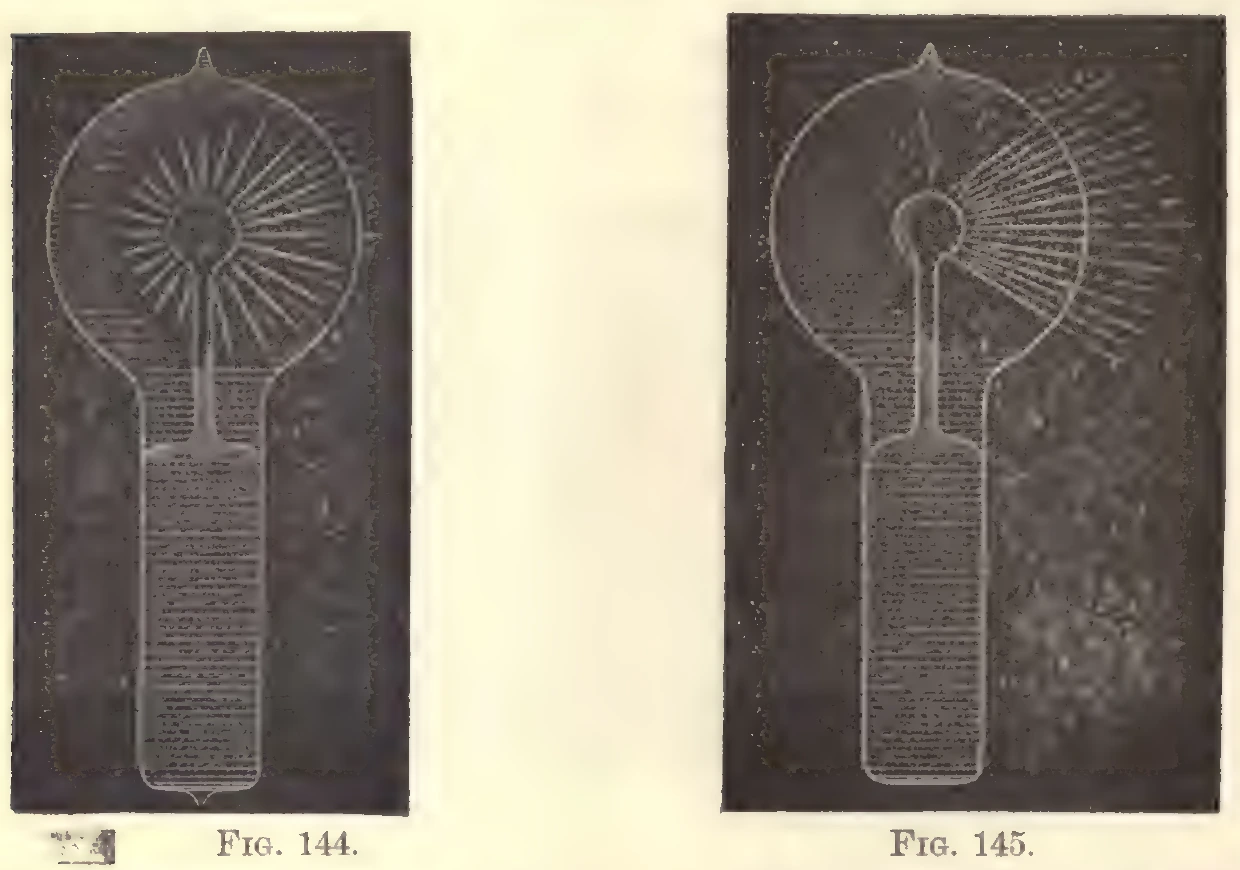
- The same chapter's account of the luminous brush formed at a single terminal in high vacuum, with the photographs of it in Figs. 144 and 145, printed pp. 226 to 228
- Chapter XXVIII, 'On Light and Other High Frequency Phenomena', a lecture delivered before the Franklin Institute, Philadelphia, in February 1893 and before the National Electric Light Association at St. Louis in March 1893; the passage on driving a motor from one line is printed pp. 333 and 334, and the plate of four plans of connection, Fig. 180, is printed p. 335
- Every quote here was re-grepped from the text layer of our scan and pinned to its printed page before drafting; the register is new_content/1894-series/02-tesla-one-wire-power/quotes.md, re-runnable with books/tools/grep_quote.py
- Pages of the 1894 edition used here: p. 184, p. 228, p. 232, p. 233, p. 234, p. 235, p. 236, p. 267, p. 333, p. 334, p. 335