Tesla's Earthquake Machine: What the 1893 Record Says
The 1894 File · No. 3 of 12. Every quote below is cited from the first edition, page numbers included.
Published: October 14, 2026 | Updated: October 14, 2026
Standfirst. Nikola Tesla demonstrated a small oscillating engine at the 1893 World's Fair in Chicago. A book published the following year reports the demonstration in detail, patent drawings exist, and the numbers in the report are specific: a twenty-pound weight thrown back and forth about eighty times a second. What the 1893 record does not contain is the earthquake. That story arrives fifty years later.
A Friday Evening in Chicago, August 1893
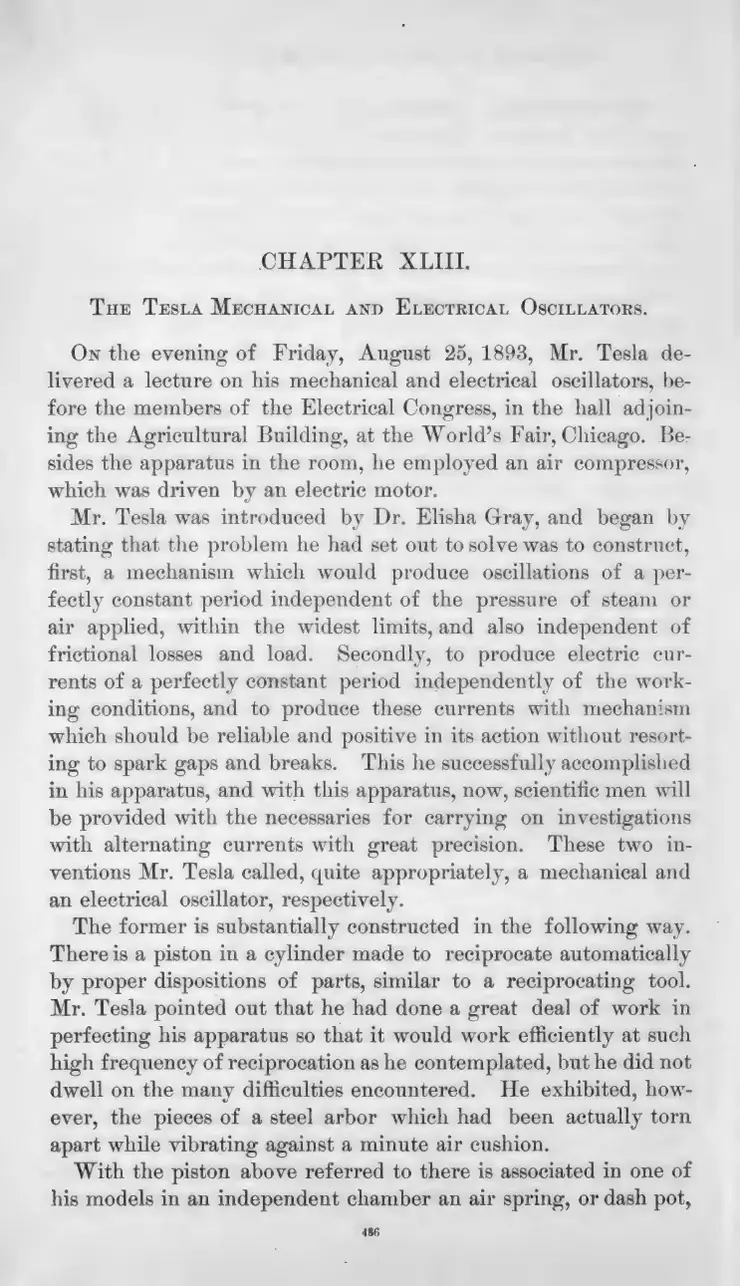
The account we rely on is in Chapter XLIII of the 1894 volume, and it is a report of a lecture, not a memoir. It opens with the date and the room: on the evening of Friday, 25 August 1893, Tesla spoke "before the members of the Electrical Congress, in the hall adjoining the Agricultural Building, at the World's Fair, Chicago" (1894, p. 486). He was introduced by Dr. Elisha Gray, the man who had fought Edison over the telephone patent, and he had an air compressor on the platform, driven by an electric motor, because the machine ran on compressed air (1894, p. 486).
Tesla's own framing of the problem is quoted in the report, and it is worth reading because it is not about earthquakes. He set out to build, first, "a mechanism which would produce oscillations of a perfectly constant period independent of the pressure of steam or air applied, within the widest limits, and also independent of frictional losses and load"; and second, to produce currents of constant period "with mechanism which should be reliable and positive in its action without resorting to spark gaps and breaks" (1894, p. 486).
That is a measurement problem. In 1893, if you wanted alternating current of high frequency in a laboratory, you usually got it from a machine interrupted by a spark gap or a mechanical breaker, which made the frequency wander and the waveform ugly. Tesla was offering a prime mover whose period you could trust.
What the Machine Actually Was
It is a piston in a cylinder, driven by steam or air, that reverses itself without a crank, "made to reciprocate automatically by proper dispositions of parts, similar to a reciprocating tool" (1894, p. 486). Instead of a flywheel, it carries a mass. Instead of a mechanical valve gear timing the reversals, the timing comes from the natural oscillation of the mass against a cushion of compressed air trapped in the cylinder ends.
The report goes out of its way to say how much trouble this was. Tesla "had done a great deal of work in perfecting his apparatus so that it would work efficiently at such high frequency of reciprocation as he contemplated", and he showed the audience the evidence: "the pieces of a steel arbor which had been actually torn apart while vibrating against a minute air cushion" (1894, p. 486). A shaft pulled in half by its own vibration, against a pocket of air only a few millimetres thick. That is the machine's whole difficulty in one exhibit.
The elegance is in the spring. The report says that in the arrangement Tesla showed, "no matter what the rigidity of the spring and no matter what the weight of the moving parts... the vibrations of the spring are always isochronous with the applied pressure" (1894, p. 487). Change the steam pressure and you change the stroke, not the rate. The report compares the behaviour to a musical instrument: the system "acts exactly like a string tightly stretched between two points, and with fixed nodes, so that slight changes of the tension do not in the least alter the period of oscillation" (1894, p. 487).
The Numbers
These are the figures the 1893 report gives, and they are the reason the machine is worth writing about rather than shrugging at:
- a weight of "approximately 20 pounds at the rate of about 80 per second", with a stroke
the printed page sets as a fraction the OCR mangles into "f- inch", meaning about three-eighths of an inch (1894, p. 487);
- the same weight vibrated "many hundred times" per second when the stroke was shortened,
which the report says had already been done in other experiments (1894, p. 487);
- starting it took "a powerful blow", but could be arranged so that "only a minute effort
is required to start", or by slamming the pressure on (1894, p. 487);
- a trick to compensate for temperature: the dash-pot chambers were opened to the outside air
so the trapped air kept the same mean density as the atmosphere, giving "a spring of constant rigidity" (1894, p. 487);
- and a clock. Tesla showed a small motor driven by these currents at constant speed
regardless of the air pressure applied, and "a clock so constructed that it could be attached to one of the oscillators, and would keep absolutely correct time" (1894, p. 488).
Eighty hertz from a piston and an air spring in 1893, with a clock hanging off it as a demonstration of timing stability. The point of the demonstration was regularity, not violence.
Why a Constant-Period Machine Mattered Then
The 1894 report states the intended use plainly: "The first is, of course, to produce electric currents" (1894, p. 487), and Tesla coupled the piston to a generator, adding a condenser and self-induction so the electrical system and the mechanical system shared a period and "electrical and mechanical resonance is obtained, and maintained absolutely unvaried" (1894, p. 488).
Read that against the rest of the book and the ambition is clear. Tesla's work with high frequency current needed a steady supply. The same volume describes an experimental machine at "about 15,000 alternations per second" and a later one with 480 polar projections running at 30,000 (1894, pp. 376, 381; we take that machine apart in Tesla's 30,000 alternations per second). A reciprocating machine locked to its own resonance was one route to that.
It did not survive. The oscillator was superseded by rotary alternators driven by steam turbines, which by the early 1900s had displaced reciprocating engines as the prime movers of central power stations. That is a fact about engineering history, not about Tesla's ability, and any honest account of this machine has to include it (Wikipedia, "Tesla's oscillator"; Carlson, 2013).
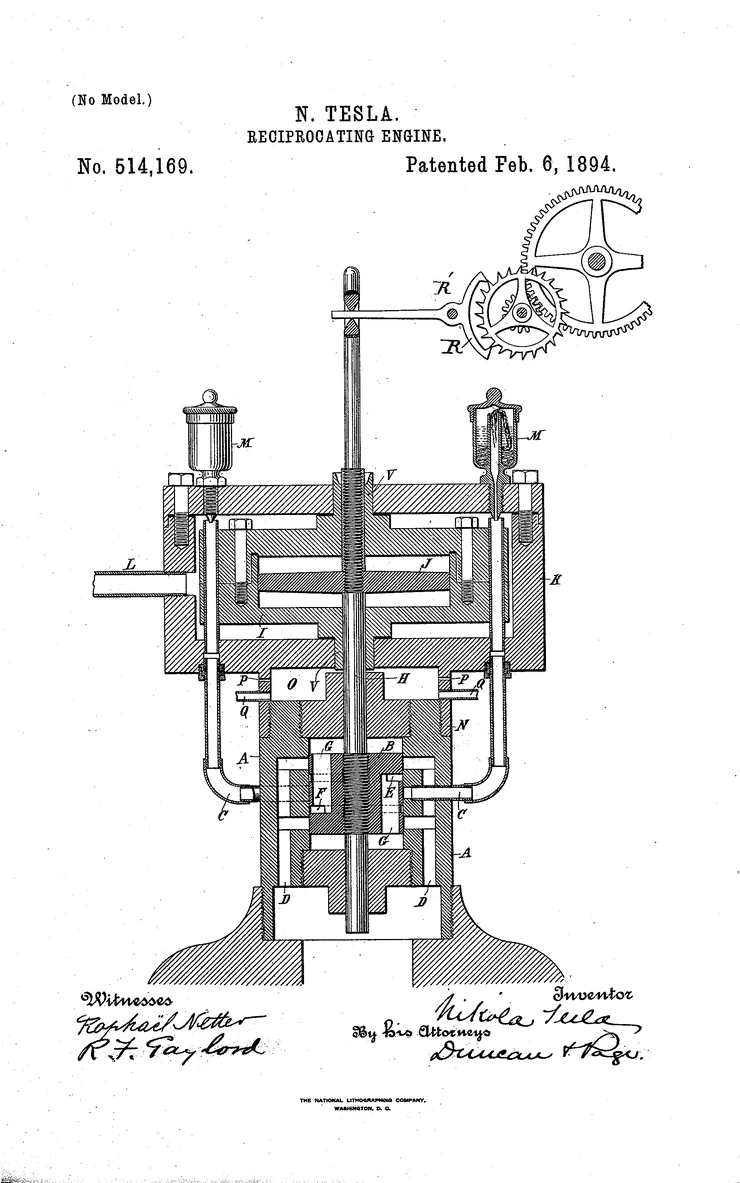
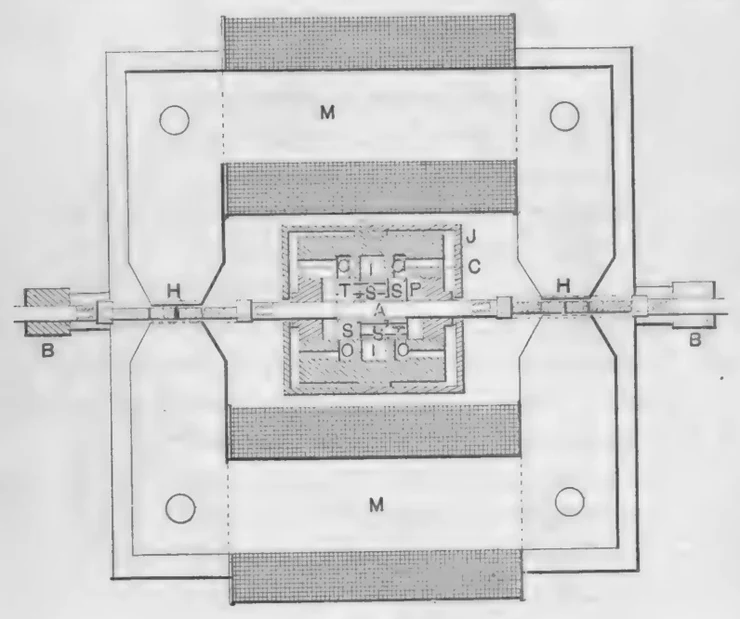
The machine is not hypothetical. Tesla patented it: US patent 514,169, "Reciprocating Engine", filed 19 August 1893 and granted 6 February 1894 (patent record). The book's own illustration of the device, Fig. 313 on p. 491, is the only engraving the chapter carries, and it shows the magnetic frame and coils that made the piston a generator as well as an oscillator: "The apparatus here illustrated was intended for demonstration purposes, air being used as most convenient for this purpose" (1894, p. 491).
The Earthquake Story, Dated Properly
Here is the timeline, because most retellings collapse it.
- 1893 and 1894. The Chicago demonstration, the book's report, the patent. No mention
of an earthquake.
- 1935. Tesla, aged 79, tells an interviewer about a small oscillator run at his
Houston Street laboratory, and about the building shaking.
- 1944. The story is first printed, in John J. O'Neill's Prodigal Genius
(pages 162 to 164).
There is no 1898 newspaper record of the incident, and nothing in the literature of those years that resembles it. That does not make Tesla a liar. It makes this an anecdote with a fifty-year gap between the event and the publication, which is exactly the kind of thing we should label rather than repeat.
What the Internet Gets Wrong
Search the machine and you will find a sledgehammer, a police officer evacuating the neighbourhood, a multi-ton basement machine, and Tesla stopping the experiment by smashing it with a hammer. Those details vary between retellings, and none of them is in the 1894 book.
The claim has been tested. In MythBusters episode 60 (aired 30 August 2006), the team built versions of the oscillator and attached one to a large truss bridge. It matched the bridge's frequency and produced "a vibration noticeable 100 ft away", but was "not strong enough to be considered an earthquake", and the myth was declared busted (mythresults.com/episode60).
So the accurate version is smaller than the legend and more interesting: a hand-sized machine that could be felt a hundred feet away, and that could shake its own frame apart.
Resonance Is Real; Over-Unity Is Not
Resonance is why a small machine can be felt across a bridge. It is not a source of energy. A resonant system stores and returns energy, so the amplitude you get is a question of damping and of how much you put in. That is why a constant-period oscillator is a beautiful timing device and not a free-power device.
That distinction is the whole reason this site links history to hardware. If you have been promised a machine that runs itself, read the truth about perpetual motion and the magnet motor claim. For the nine machines this same book describes that other people did not go on building, and for the only 'magnetic generator' the 1894 volume actually prints, which turns out to be a heat engine, see 9 Tesla Inventions From 1894 That Never Caught On. For the 1893 setting of the demonstration, Tesla at the World's Fair covers the same year from the other end, and the paper Tesla scribbled in pencil gives the 1888 machine that really does turn alternating current into torque, with the efficiency figures attached.
Frequently Asked Questions
Did Nikola Tesla Really Build an Earthquake Machine?
He built a small steam- or air-driven mechanical oscillator and demonstrated it at the 1893 World's Fair in Chicago. It is described in an 1894 book, page 486, and patented as US patent 514,169 in February 1894. It was not called an earthquake machine at the time.
Did Tesla's Oscillator Cause an Earthquake in New York?
That story comes from Tesla himself, told in 1935 when he was 79, and it was first printed in John J. O'Neill's biography Prodigal Genius in 1944. Nothing in the published record of 1893 and 1894 mentions it. MythBusters built one in 2006 and declared the earthquake claim busted.
How Powerful Was Tesla's Oscillator?
The 1893 report describes a weight of about 20 pounds vibrated at about 80 cycles per second with a stroke of roughly three-eighths of an inch, and says the same weight had been vibrated at much shorter strokes many hundred times.
Why Don't We Use Oscillating Generators Today?
Because the problem they solved went away. A constant-frequency alternator without spark gaps mattered in 1893; rotary alternators driven by steam turbines solved the same problem better, and did it at larger sizes.
Resonance is a real engineering effect, and it is the honest part of the Tesla story. If you want a build you can actually finish, the plans we recommend come with a parts list and a frank answer about output.
We earn a commission if you buy through that link. It does not change what the 1894 book says.
Sources
- The Inventions, Researches and Writings of Nikola Tesla, ed. Thomas Commerford Martin. New York: D. Van Nostrand, 1894 (entered 1893). Scan: archive.org item inventionsresear00martiala. Public domain.
- US patent 514,169, "Reciprocating Engine", Nikola Tesla, filed 19 Aug 1893, issued 6 Feb 1894
- MythBusters episode 60, "Earthquake Machine", aired 30 Aug 2006, results transcript
- Wikipedia, "Tesla's oscillator", summary of the oscillator's supersession by steam turbines (secondary source, checked 2026-10-09)
- W. Bernard Carlson, Tesla: Inventor of the Electrical Age (Princeton University Press, 2013), background on the oscillator and the 1893 Electrical Congress
- Pages of the 1894 edition used here: p. 486, p. 487, p. 488, p. 491